

Yes, crimping barbs to make hooks barbless is a smart move, and for most trip types it should be your default before you tie on. The catch: a lazy pinch doesn’t count. You need a full flatten, a smooth profile, and a quick regulation check for the water you’re fishing.
- Fastest safe method: flat-nose pliers, fully crush the barb flush to the shank, then run the point through fabric to confirm it slides clean.
- When it matters most: treble hooks on hardware, backcountry trips where fish handling needs to be fast, and any water where catch-and-release survival is the goal.
- Non-negotiable step: verify your local regs. California, for example, defines barbless as removed, bent completely closed, or manufactured without a barb, and other states word it differently.
Key Takeaways
Barbless hook crimping works when the barb is fully flattened, verified with a fabric test, and paired with zero-slack fighting technique to keep landing rates high.
| Point | Details |
|---|---|
| Crimp fully, not partially | A half-pinched barb leaves a bump that snags fabric and still injures fish. |
| Verify with the fabric test | Push the point through cloth; any drag means the barb isn’t flat enough. |
| Check local regulations first | Rules on what counts as barbless vary by state and fishery zone. |
| Fight with zero slack | Steady tension prevents the stiletto back-out effect once the barb is gone. |
| Choose manufactured barbless when possible | Purpose-made hooks preserve point geometry better than hand-crimped conversions. |
Ready to stock your box with hooks and blades built for real conditions on the water? Browse High Class Tackle Co.'s terminal tackle collection for premium hooks and components designed to perform whether you crimp them barbless or fish them straight from the pack.
Table of Contents
- Why Bother With Barbless Hook Crimping?
- Is Crimping a Barb Actually Legal Where You Fish?
- Which Tools Actually Work for Crimping Fishing Gear?
- How Do You Crimp a Barbless Hook Correctly?
- Do You Fight Fish Differently on Barbless Hooks?
- How Long Do Crimped Hooks Actually Last?
- What Has Nick Learned From Years of Crimping Hooks on the Water?
- What Actually Matters More: The Crimp or the Technique?
- Sources
Why Bother With Barbless Hook Crimping?
A barb isn’t just a snag guard. It’s a second wedge sitting behind the point, and that wedge does two things: it makes the hook harder to drive in, and it locks the hook in place once it’s through. Crimp that wedge flat and you change both halves of the equation. The hook slides in with less resistance, and it slides out just as easily, which is exactly what you want when you’re releasing a fish, and exactly what you don’t want if you go slack for even a second mid-fight.
The payoff shows up in the release. The National Park Service’s catch-and-release guidance points to shorter handling time and less tissue damage as the main benefits of fishing barbless, though it’s clear that gear choices, like knotless rubber nets, matter just as much as the hook itself. Less time fumbling with a stuck hook means less time the fish spends out of the water gasping on your hands.
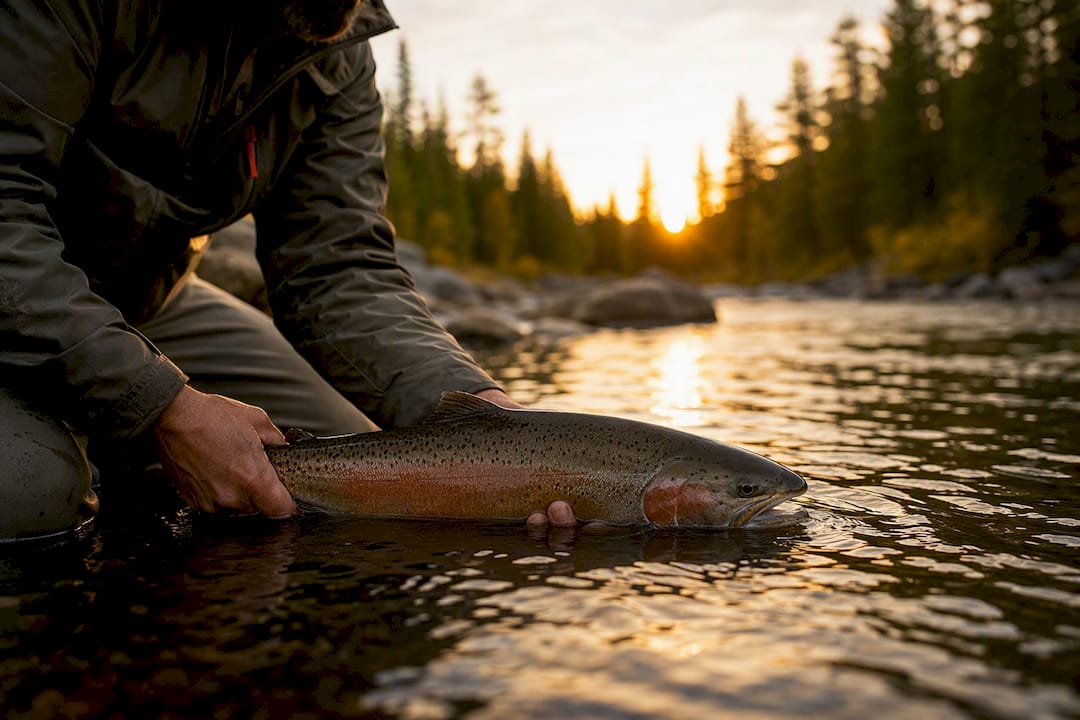
Here’s the trade-off nobody puts on the package: barbless fishing techniques demand more from you as the angler. You lose the built-in insurance policy the barb used to provide, so a bump in the rod, a dropped tip, or a moment of slack line can let a fish shake free. Guides sometimes stick with barbed hooks for first-timers because novice anglers without zero-slack technique can lose more fish on barbless setups.
Best fits for crimping: trout, salmon, steelhead, and most inshore saltwater species respond well to barbless rigs, especially on light to medium tackle where penetration force matters less.
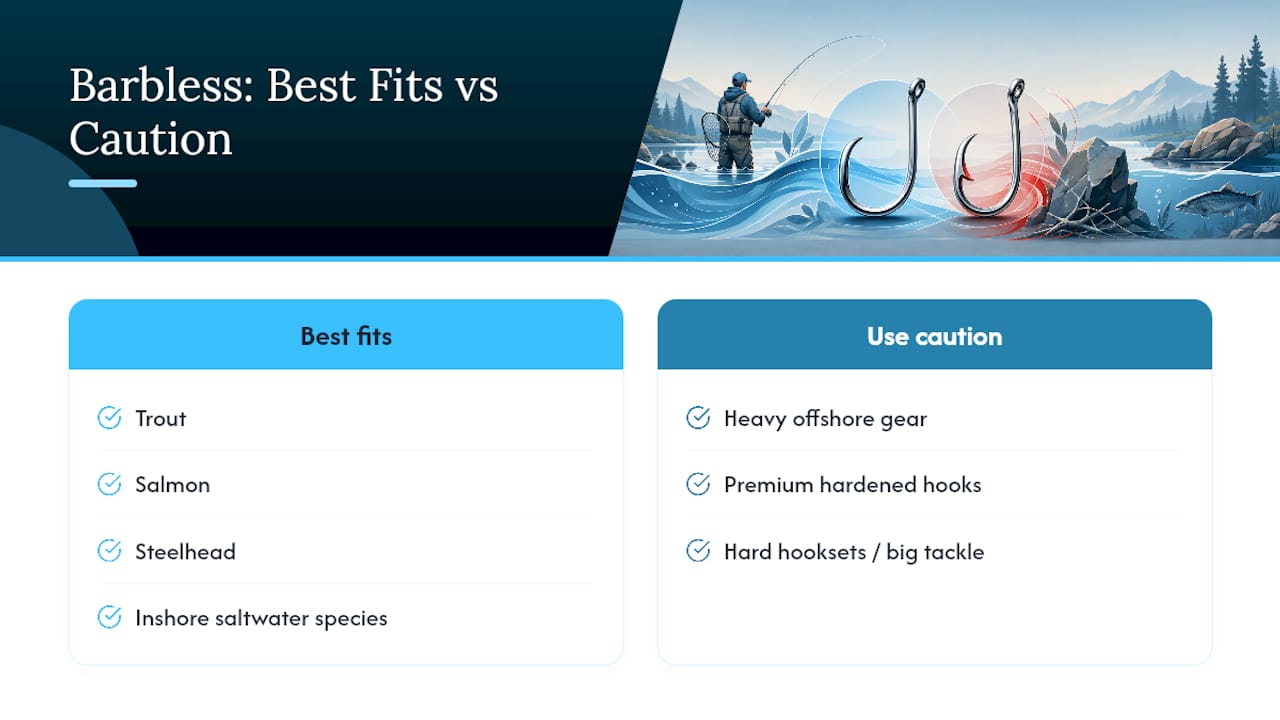
Use caution with: heavy offshore gear where a hard hookset is already a fight, and premium hardened hooks where a rough crimp risks cracking the wire instead of just flattening it.
Is Crimping a Barb Actually Legal Where You Fish?
Regulators generally accept three paths to “barbless,” and knowing them saves you a citation and an argument at the boat ramp. California’s fishing regulations spell it out clearly: a hook counts as barbless if the barb is removed, bent completely closed, or the hook was manufactured without one. Crushing it flat with pliers satisfies that standard in most jurisdictions that use similar language, but “most” isn’t “all,” so don’t assume your home water’s rules travel with you.
Confirming compliance takes thirty seconds if you know the trick. Here’s the sequence guides use before every trip:
- Pinch the barb flat with your tool of choice until it sits flush against the shank, not just dented.
- Run the point through a scrap of fabric (an old T-shirt works fine) and pull it back out. If it snags or drags, the barb isn’t flat enough.
- Check it visually under decent light. A properly crushed barb leaves no raised edge you can feel with a fingernail.
- Cross-reference the water you’re fishing. Rules vary by state and even by fishery zone, so pull up the current regs before you leave the truck. Our breakdown of Oregon’s barbless-hook rules by fishery is a good example of how granular this gets.
The fabric test is a practitioner’s shortcut, not an official regulation, but it’s the fastest way to catch a half-crimped hook before a warden or a fish finds the problem for you.
Pro Tip: Never settle for a “good enough” pinch. A partially crushed barb leaves a bump that snags fabric, tears flesh, and can still fail a barbless check even though you technically squeezed the pliers.
Which Tools Actually Work for Crimping Fishing Gear?
Not all pliers are built for this job, and the wrong tool turns a thirty-second task into a mangled hook. Flat-nose pliers give you the widest, most even contact surface, which matters because you want to crush the barb, not just dent one side of it. Needle-nose pliers work in a pinch for small trebles but tend to concentrate pressure unevenly on wider barbs. A dedicated bench or hand crimper, the kind fly shops sell for exactly this purpose, gives you consistent pressure and is the better call if you’re converting a whole box of hooks at once. Hemostats are handy for tight spaces on small flies but lack the leverage for anything heavier than light wire.
- Flat-nose pliers: best all-around choice for lures, spinners, and most single hooks.
- Bench crimper: ideal for batch conversions before a trip; consistent, repeatable pressure.
- Hemostats: useful for delicate fly hooks where a full-size plier is overkill.
- Needle-nose pliers: fine for small trebles, but check both barb sides for even flattening.
Trebles on crankbaits and spoons are the most common candidates for crimping since a lure with three barbed hooks is a nightmare to release quickly. Standard single hooks used for catch-and-release should get the same treatment. The exception is hardened, premium hooks, where a heavy crimp risks micro-cracking the wire, so check manufacturer guidance before you go at those with full force.
Before any trip, run a five-minute pass: pull your box, identify every hook that’ll touch a fish you plan to release, crimp them in advance, and test each one. Protect your eyes if you’re using a bench crimper under tension, and work over a bench or vise rather than in your lap.

How Do You Crimp a Barbless Hook Correctly?
This is the part that separates a clean conversion from a hook that still snags. Follow it step by step and you’ll get manufactured-barbless performance out of a five-dollar pair of pliers.
Prep the workspace.
- Set up on a stable bench or use a small vise to hold the hook steady. Working in your lap or on a boat seat invites slipped pliers and a hook in the thumb.
- Grab flat-nose pliers or your bench crimper, whichever matches the hook gauge you’re working on.
- If you’re doing more than a handful of hooks, put on eye protection. Wire fragments occasionally pop free during a hard crush.
Compress the barb.
- Open the hook so the barb is fully exposed and align your plier jaws directly over it, perpendicular to the shank.
- Squeeze firmly and steadily rather than in short jabs. You want the barb rolled flat into the shaft, not just dented at an angle.
- Rotate the hook slightly and check both sides. Many barbs are wider than they look, and a single squeeze from one angle can leave a sliver standing.
- Repeat the compression until the barb sits completely flush. If you can feel any ridge with a fingernail, it isn’t done yet.
Smooth and verify.
- Run your fingertip along the shank where the barb used to be. It should feel like one continuous curve with no bump, no gap, and no sharp edge.
- Perform the fabric test: push the point through a scrap of cloth and pull it back. A properly flattened barb slides through clean. Any resistance means go back to step four.
- Check the point itself. Crimping shouldn’t touch the tip, but a slipped plier occasionally rolls it. If the point feels rounded instead of sharp, touch it up with a small hook file before you fish it.
Troubleshooting common problems:
- Bump remains after crimping: you flattened at an angle instead of straight down. Reposition the jaws perpendicular to the shank and squeeze again.
- Wire looks cracked or discolored: stop using that hook. This happens more often on hardened premium wire, and a heavy crimp on that kind of steel raises the risk of micro-fracture, which means the hook can fail mid-fight instead of just underperforming.
- Point got dulled during the process: a few passes with a fine hook file restores the edge. If the point feels chalky or rough no matter how much you file, retire the hook.
- Barb won’t compress fully with hand pliers: you’re likely working heavier wire than your tool is rated for. Switch to a bench crimper sized to that gauge.
Pro Tip: Keep a small scrap of denim in your tackle box specifically for the fabric test. It’s the single fastest way to catch a half-crimped hook before it costs you a fish or a warning from a game warden.
Do You Fight Fish Differently on Barbless Hooks?
Zero-slack tension is the whole game once you’ve crimped the barb. Without that second wedge holding the hook in place, any moment of loose line gives a fish room to shake the point free, an effect anglers call the stiletto back-out. Keep steady pressure through every jump, every run, and every second you’re reeling, and a barbless hook holds just as well as a barbed one.
Your rod matters more here than most anglers realize. A softer-tip or moderate-action rod absorbs sudden lunges instead of transferring that shock straight to the hook point, which is exactly when a stiff, fast-action rod lets a fish pop free. Pair that with a drag set just loose enough to give on a hard run, since a locked-down drag combined with barbless hooks is a recipe for pulled hooks on big fish.
- Rod choice: moderate or moderate-fast action gives more forgiveness on sudden strikes and headshakes.
- Drag setting: smooth and slightly loose beats locked-tight when you’re fishing barbless.
- Landing gear: a knotless rubber net keeps the fish calm and the hook seated until you’re ready to release it, which the NPS lists as just as important as the hook itself for survival rates.
- Unhooking: do it in the water whenever possible, and if a hook is buried deep, cut the line rather than tear at gill tissue trying to save a $2 hook.
For clients or newer anglers, coach the zero-slack habit before the first cast, not after the first lost fish. It’s a rod-tip discipline, not a talent, and it’s learnable in about ten minutes on the water.
How Long Do Crimped Hooks Actually Last?
A crimped barb isn’t a permanent modification you can forget about. Retire the hook if you see cracks near the crush point, thinning wire, or a burr that keeps coming back no matter how many times you flatten it. Those are signs the metal has fatigued, and a fatigued hook can snap under load exactly when you need it most.
- Re-hone, don’t replace, dull points. A few strokes with a fine hook file restores most points after crimping, and it’s worth doing before every trip, not just when the hook feels obviously blunt.
- Retire hooks with visible cracking or any spot where the wire looks discolored or flaky after crimping.
- Build a pre-trip checklist: pull your barbless conversions, run the fabric test on each one, and file any point that’s gone soft.
- Skip crimping premium hardened hooks where possible. Buy them purpose-made barbless instead, since manufactured barbless hooks preserve point geometry better than any hand conversion.
What Has Nick Learned From Years of Crimping Hooks on the Water?
Every guide develops a rule of thumb for when a barb comes off and when it stays, and Nick’s is simple: any lure carrying trebles gets crimped before it ever touches water where catch-and-release matters, no exceptions. That includes crankbaits, spoons, and swim jigs, since three barbed points on a thrashing fish turn a quick release into a five-minute ordeal every single time.
Backcountry trips get the same treatment for a different reason. When you’re two hours from a road and a hook goes through your palm instead of a fish’s jaw, barbless is the difference between a minor annoyance and an evacuation.
The fish doesn’t care how sharp your hook looks in the box. It cares how fast you get it back in the water. That’s the whole argument for barbless, and it’s the only one that matters.
- Convert trebles on lures before every trip where you plan to release fish.
- Keep a spare box of pre-crimped hooks so you’re never modifying gear streamside under pressure.
- Check regional rules first. Our guide to barbless regulations in Oregon breaks down zone-specific quirks that trip up visiting anglers.
- Pair barbless hooks with the right terminal setup. Our steelhead hook guide covers which styles hold up best once the barb is gone.
Responsible crimping isn’t a chore you tolerate for compliance, but a key practice in broader angling techniques and responsible fishing. It’s the small habit that keeps more fish swimming away strong, which is the entire point of catch-and-release in the first place.
What Actually Matters More: The Crimp or the Technique?
The research here supports a conclusion most gear guides skip past: the crimp itself is the easy part. Anyone can flatten a barb with pliers in thirty seconds. What actually determines whether that fish survives, and whether you land it in the first place, is what you do with your rod tip for the next ninety seconds after the strike.
Conventional advice treats barbless hooks like a settings toggle: flip it on, feel virtuous, move on. That undersells the skill gap. A crimped hook in the hands of someone who lets the line go slack for even a second is worse than a barbed hook fished competently, because you get the reduced hooking security without the safety net.
If you take one thing from this guide, prioritize the fight technique first and the crimping second. Learn zero-slack tension before you ever crimp a barb, then make the conversion a habit rather than an afterthought. Buy purpose-made barbless hooks for anything you fish often, and reserve hand crimping for the lures and hooks you’re not ready to replace outright. That order of operations is what actually protects fish, not the hook alone.
— Nick
Sources
- California Department of Fish and Wildlife — Sport Fishing general provisions
- National Park Service — Catch and release best practices
- Master Fishing Mag — Barbless hooks physics: penetration force & data guide
- Fishing Adventures Guide — Using barbless hooks: benefits for you and the fish
Recommended
- Barbless Hooks in Oregon: 2026 Rules by Fishery and Zone – High Class Tackle Co.®
- Types of Hooks for Steelhead Fishing: PNW Guide – High Class Tackle Co.®
- Brad Cut Plug Mastery: Expert Rigging Guide for PNW Anglers – High Class Tackle Co.®
- Cut Plug Herring Rigging for Chinook: A PNW Angler’s Guide – High Class Tackle Co.®
0 comments