

Water current is the single most important factor controlling where steelhead hold, feed, and move in any river system. The role of current in steelhead fishing comes down to one principle: steelhead position themselves where the water does the work for them. They rest in slower flows while food arrives on the adjacent fast current. Understanding this behavior separates anglers who consistently find fish from those who work hard water all day without a bite. This guide breaks down current speeds, seams, boundary layers, and the biological instincts that make steelhead predictable when you know what to look for.
What current speeds define the best steelhead holding water?
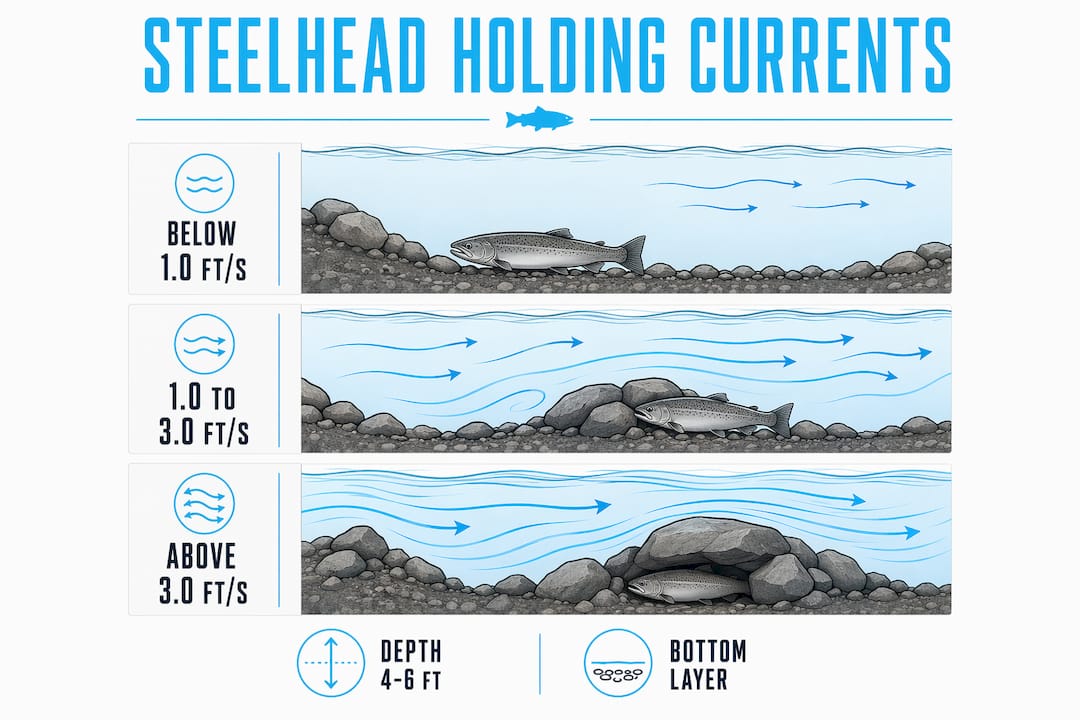
Optimal steelhead holding water runs between 1.0 and 3.0 feet per second, typically at depths of 4–6 feet near bottom structure that slows the flow. That walking-pace current is the sweet spot. Fast enough to carry food, slow enough for a fish to hold without burning calories. Steelhead park behind boulders, along drop-offs, and on shelves where the riverbed breaks the current and creates a cushion of slower water at depth.
Most anglers make the mistake of reading current speed at the surface and calling it done. Surface velocity and bottom velocity are two different things entirely. Bottom current runs 20–40% slower than what you see on top due to friction with the riverbed. That gap matters because steelhead hold in the bottom layer, not the surface layer. Your bait needs to be down there, moving at the speed of the water the fish is actually sitting in.
Temperature also interacts with current to shape where fish hold. Steelhead feed most actively at water temperatures of 40–45°F. In colder water, they drop into slower, deeper pockets and become less aggressive. In warmer water within that range, they push into moderate current and feed more freely. Knowing both the current speed and the water temperature gives you a two-variable map for finding fish fast.
| Current condition | Steelhead behavior | Angler adjustment |
|---|---|---|
| Below 1.0 ft/s (slack water) | Fish scatter or move through | Cover water quickly, don’t linger |
| 1.0–3.0 ft/s (walking pace) | Prime holding and feeding zone | Slow down, work thoroughly |
| Above 3.0 ft/s (heavy chop) | Fish drop to bottom structure | Add weight, fish deeper seams |
| 40–45°F water temperature | Active feeding in moderate current | Target mid-depth runs and tailouts |
Pro Tip: Wade into the river and watch how fast a leaf drifts past your knee. If it moves at a brisk walking pace, you’re standing in prime steelhead water. If it rockets past, the fish are holding somewhere slower nearby.
How do current seams and boundary layers influence steelhead positioning?
Current seams are the most productive zones in any steelhead river. A seam forms where fast water meets slow water, and fish locate these seams to rest in the slower side while intercepting food carried by the faster side. Think of it as a steelhead’s version of a drive-through window. They expend almost no energy while the river delivers their meal.
Identifying seams on the surface takes practice. Look for these visual cues:
- V-wakes on the surface: A downstream-pointing V usually indicates a submerged boulder or ledge creating a seam behind it.
- Bull-eye ripples: Circular disturbances on an otherwise uniform surface signal upwelling current from submerged structure 4–6 feet down.
- Foam lines: Bubbles and debris collect along the boundary between fast and slow water, marking the seam’s exact edge.
- Color transitions: A subtle shift from darker to lighter water often signals a depth change where current slows near a shelf or drop-off.
The boundary layer near the riverbed is the other critical zone. Bottom current is 20–40% slower than surface current because friction with the riverbed bleeds off velocity. Steelhead exploit this layer constantly. They hold just above the bottom, where the current is slowest, and dart up to grab food drifting overhead. Anglers who ignore this subsurface current variation and fish their bait at mid-column are presenting above where the fish actually sit.
Seams are identifiable by subtle surface features like v-wakes or bull-eyes, often indicating submerged structure 4–6 feet deep. That depth range matches the prime holding depth almost exactly. When you spot one of those surface signals, you are looking at a fish-holding zone. Cast to it with confidence.
How does rheotaxis shape steelhead behavior and fishing tactics?
Rheotaxis is the biological term for a fish’s instinct to orient itself into the current. Steelhead position head-first into the flow to detect vibrations and food particles through their lateral line, the sensory organ running along each side of their body. This is not optional behavior. It is hardwired. Every steelhead in the river is facing upstream, which means every effective presentation must come from upstream and drift naturally toward the fish.
Understanding rheotaxis changes how you approach a run. Here is how to use it:
- Position yourself downstream of your target zone. You are casting up and across, not down. The fish faces you, which means your bait arrives in its field of view naturally.
- Cast at a 30–45° angle upstream. This angle gives your bait time to sink to the bottom layer before it reaches the holding zone. A straight upstream cast sinks too fast. A straight across cast drags immediately.
- Match your drift speed to the bottom current. Guide Jeff Goodwin advises that presenting bait slightly slower than the current is less likely to be rejected than a bait moving faster than the flow. Steelhead are suspicious of food that moves unnaturally fast.
- Watch your line, not the water. A steelhead strike in slow bottom current is often subtle. A slight hesitation or upstream tick in your line is the signal to set the hook.
Rheotaxis also explains why steelhead fight so hard when hooked. Their instinct is to drive upstream into the current, using the flow against you. That same biological drive that makes them predictable to find makes them brutal to land.
Pro Tip: Before your first cast, crouch down and watch the water at eye level for 60 seconds. You will see current variations you completely missed while standing upright. That low angle reveals seams, eddies, and subtle surface breaks that tell you exactly where to cast.
What practical techniques help anglers adapt to varied currents?
Current changes constantly across a river, and your technique needs to change with it. A presentation that works in a slow tailout fails in a heavy run. Adapting your rigging, casting angle, and mending to match subsurface conditions is what separates consistent anglers from occasional ones.
The most common mistake is ignoring line belly. After your cast lands, surface current grabs your line and pulls it downstream faster than your bait. This creates a belly in the line that drags your bait off the bottom and out of the strike zone. Line belly reduces bottom contact sensitivity significantly, meaning you feel less and miss more. An immediate upstream mend right after the cast corrects this before it starts.
Key technique adjustments for varied currents:
- Add weight for heavy current. Your bait should tick the bottom every few seconds. If it never touches, add a split shot. If it drags constantly, remove one. The goal is light, intermittent contact with the riverbed.
- Mend upstream immediately after casting. Do not wait. The moment your line hits the water, flip the rod tip upstream to reposition the line above your bait. This kills the belly before it forms.
- Target current breaks, not the main flow. The fish are not in the fastest water. They are in the seam just beside it. Cast to the edge of the fast water, not the center.
- Work tailouts thoroughly. The tail end of a pool is where current accelerates before dropping into the next run. Steelhead stack here, especially during low-light periods. Slow your drift and cover every inch.
- Use steelhead fishing line suited to current conditions. Heavier monofilament handles fast water better. Lighter fluorocarbon gives you a natural drift in slow, clear runs. Line choice affects how your bait behaves in the current as much as weight selection does.
Experienced anglers mentally map river flow from a fish’s perspective to identify strategic casting zones along current breaks and seams. That mental model is a skill you build over seasons, but you can accelerate it by fishing one run thoroughly before moving. Slow down, read the water, and let the current tell you where the fish are.
Pro Tip: When you find a productive seam, mark it mentally relative to a fixed landmark on the bank, like a specific tree or rock. Current seams form in the same spots every season because the underlying structure never moves. That seam that produced fish in november will hold fish again next year.
Key takeaways
Current controls steelhead location, feeding behavior, and strike response, making current reading the most transferable skill in river fishing.
| Point | Details |
|---|---|
| Optimal holding current | Steelhead hold in 1.0–3.0 ft/s water at 4–6 feet depth near bottom structure. |
| Bottom current is slower | The riverbed slows current 20–40% below surface speed; fish and bait both live down there. |
| Seams are the target | Where fast water meets slow water is where steelhead rest and feed. |
| Rheotaxis drives presentation | Steelhead face upstream always; cast from downstream and drift bait toward the fish. |
| Mend immediately | Upstream mending after every cast prevents line belly and keeps bait in the strike zone. |
Reading water like a fish: what I’ve learned after years on the river
The biggest shift in my steelhead fishing came when I stopped looking at the river as a surface and started thinking about it as a three-dimensional system. Most anglers read the top of the water. The fish live at the bottom of it. Those are two completely different environments separated by 4–6 feet of water and a 20–40% velocity difference.
The mistake I see constantly is anglers fishing uniform water. They wade into a long, flat run and work it top to bottom without ever identifying where the seams are. They cover a lot of water and catch very few fish. The angler who spends 20 minutes reading the same run before making a cast will out-fish them every time. Visualizing river flow as a swimming fish is not a metaphor. It is a practical exercise. Ask yourself: if I were a 10-pound fish that needed to hold position without burning energy, where would I stand?
The other thing I have learned is that patience with your drift pays off more than covering water fast. A bait that swings through a seam at the wrong speed gets ignored. The same bait drifted slightly slower than the current, ticking the bottom, gets eaten. Slow down. Trust the current. Let the river do the work, the same way the fish does.
— Nick
Gear built for the current at Highclasstackleco
Fishing current well requires gear that performs at the bottom of the water column, not just at the surface. Highclasstackleco builds tackle specifically for West Coast steelhead rivers, where current conditions change run to run and presentation precision is everything.

From terminal tackle and components designed for precise bottom drifts to custom spinner blades that generate the right vibration in varied flows, the Highclasstackleco lineup is built by anglers who fish these rivers hard. Browse the full collection at highclasstackleco.com and gear up for the seams, eddies, and tailouts that hold the fish you are after.
FAQ
What is the ideal current speed for steelhead fishing?
Steelhead hold most reliably in current speeds of 1.0–3.0 feet per second at depths of 4–6 feet. Water moving at a brisk walking pace near bottom structure is the prime target zone.
Why does bottom current matter more than surface current?
The riverbed slows water by 20–40% compared to the surface. Steelhead hold in this slower bottom layer, so your bait must reach and match that subsurface speed to draw strikes.
What is a current seam and why do steelhead hold there?
A current seam is where fast water meets slow water. Steelhead rest in the slower side and intercept food carried by the faster current, conserving energy while feeding efficiently.
How does rheotaxis affect steelhead fishing presentation?
Rheotaxis is the instinct that keeps steelhead facing upstream at all times. Effective presentations drift from upstream toward the fish, matching the direction food naturally travels in the current.
How do I stop my bait from dragging in fast current?
Cast at a 30–45° upstream angle and mend your line upstream immediately after the cast lands. This prevents line belly from forming and keeps your bait drifting naturally near the bottom.
Recommended
- Reading Steelhead Holding Water: River Guide 2026 – High Class Tackle Co.®
- Steelhead Spoon Fishing Rivers: PNW Angler’s Guide – High Class Tackle Co.®
- Types of fishing line for steelhead: a PNW guide – High Class Tackle Co.®
- Why Steelhead Fight Hard: Biology, Instinct, and Power – High Class Tackle Co.®
0 comments