

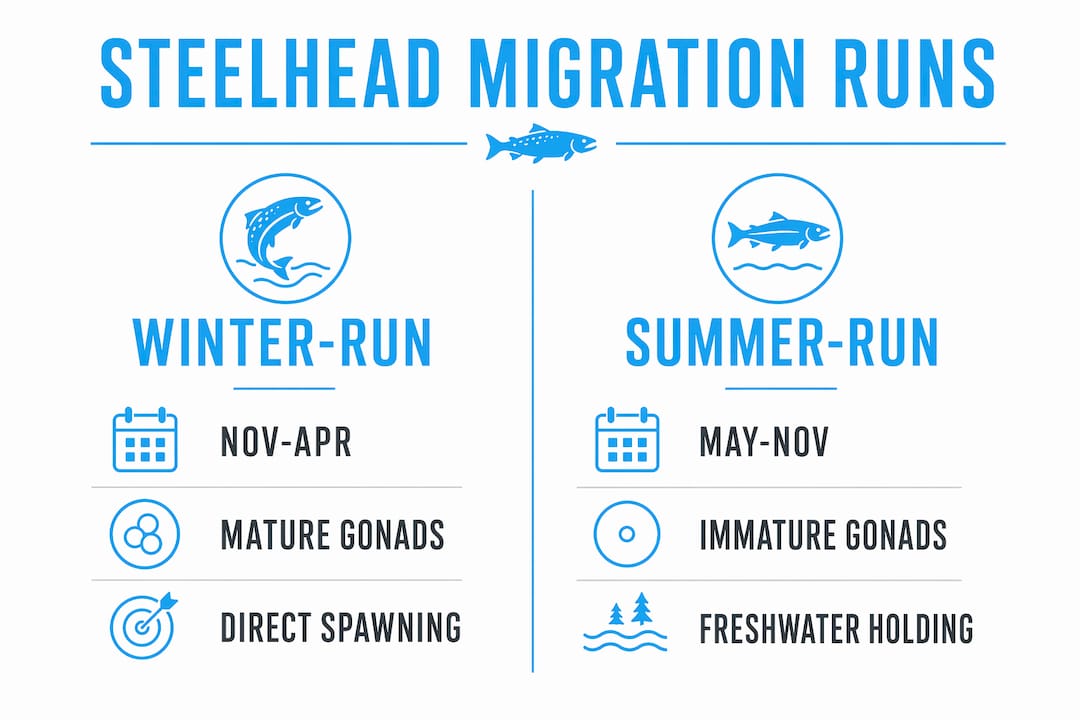
Steelhead enter rivers in two distinct runs driven by environmental triggers, not fixed calendar dates. Winter-run fish arrive between november and april with mature gonads and spawn relatively quickly. Summer-run fish push in from may through november with immature gonads, then hold in freshwater for months before spawning the following spring. Water temperature, photoperiod, and river flow control when each run moves. Knowing which run is in the system and what biological state those fish are in changes everything about how you fish for them.
How steelhead enter rivers: triggers and timing
Steelhead river migration does not follow a calendar. Upstream movement begins when water temperatures climb above 40°F (4°C), river flows rise, and day length shifts. Those three cues work together. When all three align, fish move.
Key environmental triggers that control steelhead entry:
- Water temperature: Fish hold in saltwater or estuaries until river temps exceed 40°F. Water above 68°F (20°C) causes severe stress and blocks migration routes entirely.
- Photoperiod: Day length signals the fish’s endocrine system to prepare for migration. Summer-run fish respond to lengthening days in spring; winter-run fish respond to shortening days in fall.
- River flow: Heavy rains trigger synchronized runs, especially in fall after salmon migrations wind down. Fish move in pods, not as individuals.
- Weather variability: A cold, wet october can advance a winter run by several weeks. A warm, dry fall can delay it just as dramatically.
The practical takeaway is that runs shift year to year. Anglers who watch river gauges and temperature logs consistently outfish those who rely on last year’s dates.
Pro Tip: Check your local river’s USGS gauge and temperature sensor daily during the two weeks before your target run. A sudden flow spike after rain is often the exact trigger that pushes a pod of fish into the system.
How do winter-run and summer-run steelhead differ?
The two runs are not just different timing windows. They represent fundamentally different biological strategies, and that difference shapes everything from where fish hold to how you present a lure.
Winter-run behavior and spawning
Winter-run steelhead enter rivers with mature gonads. They are ready to spawn and move with purpose. Holding periods are short. These fish are more aggressive and will respond to active presentations, swung flies, and bait fished with natural drift. The window from river entry to spawning is tight, which means you often find them in transition water rather than deep, slow pools.
Summer-run behavior and holding
Summer-run fish enter with immature gonads and hold in freshwater for 60–90 days or more before spawning the following spring. They are not actively feeding. By late summer, they are running on limited energy reserves and will not chase aggressive presentations. This is a critical distinction that most anglers miss.
Steelhead are iteroparous, meaning they can survive spawning and return to the ocean. Kelt survival varies dramatically by basin, from as low as 0.69–2% in heavily dammed systems like the Snake River to roughly 30% in shorter coastal streams. That survival gap reflects the physical cost of long migrations through degraded habitat.
| Feature | Winter-run | Summer-run |
|---|---|---|
| Entry timing | November through april | May through november |
| Gonad maturity at entry | Mature | Immature |
| Holding period | Short, days to weeks | Long, 60–90+ days |
| Feeding behavior | More aggressive | Non-feeding, metabolic |
| Best presentation | Active swings, bait drift | Dead-drift, subtle lures |
| Spawning timing | Late fall through early spring | Following spring |
Pro Tip: For summer-run fish, size down your presentation and slow everything down. A small bead or egg pattern drifted naturally at the fish’s eye level will outperform any flashy, fast-moving lure every time.
What navigation mechanisms guide steelhead home?
Steelhead do not wander into rivers randomly. They return to the exact stream where they hatched, often with meter-level accuracy. The navigation system they use is genuinely remarkable.
Two primary mechanisms drive this homing:
- Magnetoreception: Steelhead carry magnetite crystals connected directly to the trigeminal nerve. These crystals act as a biological compass, providing precise bicoordinate mapping during ocean migration. Fish record magnetic coordinates as juveniles and use them to navigate back as adults.
- Chemical imprinting: Juvenile steelhead imprint on the specific chemical signature of their natal stream. When they return as adults, they follow that scent gradient upstream, distinguishing their home river from every other tributary.
The result is a straying rate under 5% in undisturbed systems. That number tells you how precise this system is. Habitat disruption, dam construction, and altered flow regimes can break the chemical trail and push that rate higher, which is why cold-water pathway restoration matters for long-term fishery health.
For anglers, this means fish are not randomly distributed across a watershed. They are moving toward specific tributaries. Learning which tributaries hold natal populations for each run puts you in the right water at the right time.
How can anglers use steelhead migration knowledge to fish better?
Understanding steelhead spawning behavior and migration timing is not just biology trivia. It directly translates to more fish on the line and more responsible time on the water.
-
Match your timing to the run. Winter-run fish peak in december through february on most Pacific Northwest rivers. Summer-run fish are accessible from june onward but require patience and a different approach. Check steelhead holding water conditions before you go.
-
Read the water by temperature. Fish hold in thermal refuges when mainstem temps climb. Target tributary mouths, shaded runs, and spring-fed seams during warm spells. Cold water concentrates fish.
-
Adjust your presentation to the run. Winter-run fish respond to proven bait options fished with an active, natural drift. Summer-run fish require dead-drift techniques with minimal action. Anglers often mistake summer-run fish’s lack of aggression for laziness. It is a biological energy constraint, not a mood.
-
Anchor your boat correctly in holding water. Positioning matters when you are working a pod of fish in a deep run. Proper boat anchoring technique keeps you over the fish without spooking them.
-
Protect spawning beds. Female steelhead create redds by tail-beating gravel up to 12 inches deep. These sites are visible as light-colored, disturbed patches on the riverbed. Walking through them or fishing directly over them destroys recruitment. Give redds a wide berth.
Pro Tip: When you spot a redd, mark the location mentally and fish the water 20–30 feet upstream or downstream. Pre-spawn fish stage near redds before moving onto them. That staging water is where your best shots are.
Key Takeaways
Steelhead river migration is controlled by water temperature, photoperiod, and flow, and the two distinct runs require completely different fishing strategies.
| Point | Details |
|---|---|
| Two distinct runs | Winter-run fish enter with mature gonads; summer-run fish enter immature and hold for months. |
| Environmental triggers | Water temperature above 40°F, rising flows, and photoperiod cues control entry timing. |
| Navigation accuracy | Magnetoreception and chemical imprinting produce a straying rate under 5% in healthy systems. |
| Presentation strategy | Summer-run fish require dead-drift techniques; winter-run fish respond to active, natural presentations. |
| Redd protection | Avoid fishing directly over visible spawning beds to protect future fish recruitment. |
What I’ve learned watching steelhead runs shift year to year
The biggest mistake I see anglers make is treating steelhead runs like a train schedule. They show up on the same weekend every year, fish the same hole, and wonder why the bite is dead. The fish moved two weeks early because october was cold and wet. Or they are still sitting in the estuary because the river is running warm.
Climate patterns are genuinely shifting steelhead migration norms on West Coast rivers. Runs that were historically predictable within a two-week window are now variable by a month or more in some systems. That is not speculation. You can see it in the catch data from Washington and Oregon rivers over the past decade.
The anglers who consistently put fish on the bank are the ones who treat every season as new data. They watch temperature logs, check flow gauges, and talk to guides who were on the water last week. They also understand that a summer-run fish sitting in a deep, cold pool in august is not going to eat your spinner no matter how many times you throw it. That fish needs a tiny, dead-drifted presentation at its exact depth.
Respecting the fish’s biology is not just ethical. It is the most effective fishing strategy there is.
— Nick
Gear built for every stage of the steelhead run
Steelhead fishing demands different tools for different stages of the migration. A winter-run fish in high, cold water needs a completely different setup than a summer-run fish holding in a low, clear pool in july.

Highclasstackleco builds gear specifically for Pacific Northwest steelhead conditions. From terminal tackle and components designed for precise dead-drift presentations to flashers and bait rigs that perform in heavy winter flows, the lineup covers both runs. Head to Highclasstackleco to browse the full 2026 steelhead collection. Whether you are chasing winter chrome or working a summer-run pod in low water, the right gear makes the difference between a slow day and a screaming reel.
FAQ
When do steelhead typically enter rivers?
Steelhead enter rivers in two runs: winter-run from november through april, and summer-run from may through november. Exact timing shifts based on water temperature, flow, and photoperiod rather than fixed dates.
Why do summer-run steelhead enter rivers so early?
Summer-run fish enter rivers with immature gonads and hold in freshwater for 60–90 days or more before spawning the following spring. They enter early to avoid warm ocean conditions and secure holding water before river temperatures rise.
How do steelhead find their home river?
Steelhead use magnetite crystals in their bodies to map magnetic coordinates during ocean migration, then follow chemical imprints from their natal stream to return with high accuracy. Straying rates stay under 5% in undisturbed systems.
Should I fish near steelhead spawning beds?
Avoid fishing directly over redds, which appear as light-colored, disturbed gravel patches. Female steelhead displace gravel up to 12 inches deep to create these nests. Target staging water 20–30 feet upstream or downstream instead.
What water temperature is best for steelhead migration?
Steelhead migrate most actively when river temperatures exceed 40°F (4°C). Temperatures above 68°F (20°C) cause severe physiological stress and can halt upstream movement entirely.
Recommended
- Reading Steelhead Holding Water: River Guide 2026 – High Class Tackle Co.®
- Steelhead Spoon Fishing Rivers: PNW Angler’s Guide – High Class Tackle Co.®
- Why Steelhead Fight Hard: Biology, Instinct, and Power – High Class Tackle Co.®
- Types of fishing line for steelhead: a PNW guide – High Class Tackle Co.®
0 comments