

For most 4-stroke kicker setups, the fastest path to steady, repeatable trolling speed is a high-resolution dial controller like the iTroll G3, a wired servo kit like the Trollmaster Pro, or a wireless system like the TAILFIN Kicker Steering System. Each solves the same problem, holding your kicker at a whisper-thin throttle setting, differently. Before you buy anything, check your motor’s make, horsepower, and year against the manufacturer’s compatibility chart. That single step determines which hardware kit actually bolts up.
TL;DR:
- Most high-resolution throttle controllers are compatible only with specific motor makes, horsepower, and model years, so verify these details first.
- Wired and wireless controllers differ in complexity, with wired units offering more precise control and wireless setups providing greater mobility but higher cost.
- These controllers do not improve acceleration or top speed; their purpose is to maintain a steady, low trolling speed with high repeatability.
- Proper installation requires matching linkage type, running a dedicated fused circuit, and calibrating servo travel limits to prevent mechanical damage.
- Fine-tuning the speed with a tandem approach—setting slightly below target speed and finalizing with a bow-mount motor—enhances control in variable conditions.
Table of Contents
- Kicker Motor Speed Control: What It Actually Fixes
- Shortlist: Top Controller Models And What Each Does Best
- Wired Vs. Wireless: Which Control Type Fits Your Boat?
- What Should You Check Before Ordering A Kit?
- How Does A Throttle Controller Actually Control Speed?
- Mounting, Power, And Compatibility Notes
- Two Field Tips Most Anglers Skip
- Why Repeatable Speed Changed How I Fish
- Rig Up Right After You Dial In Your Speed
- Sources
- FAQ
Kicker Motor Speed Control: What It Actually Fixes
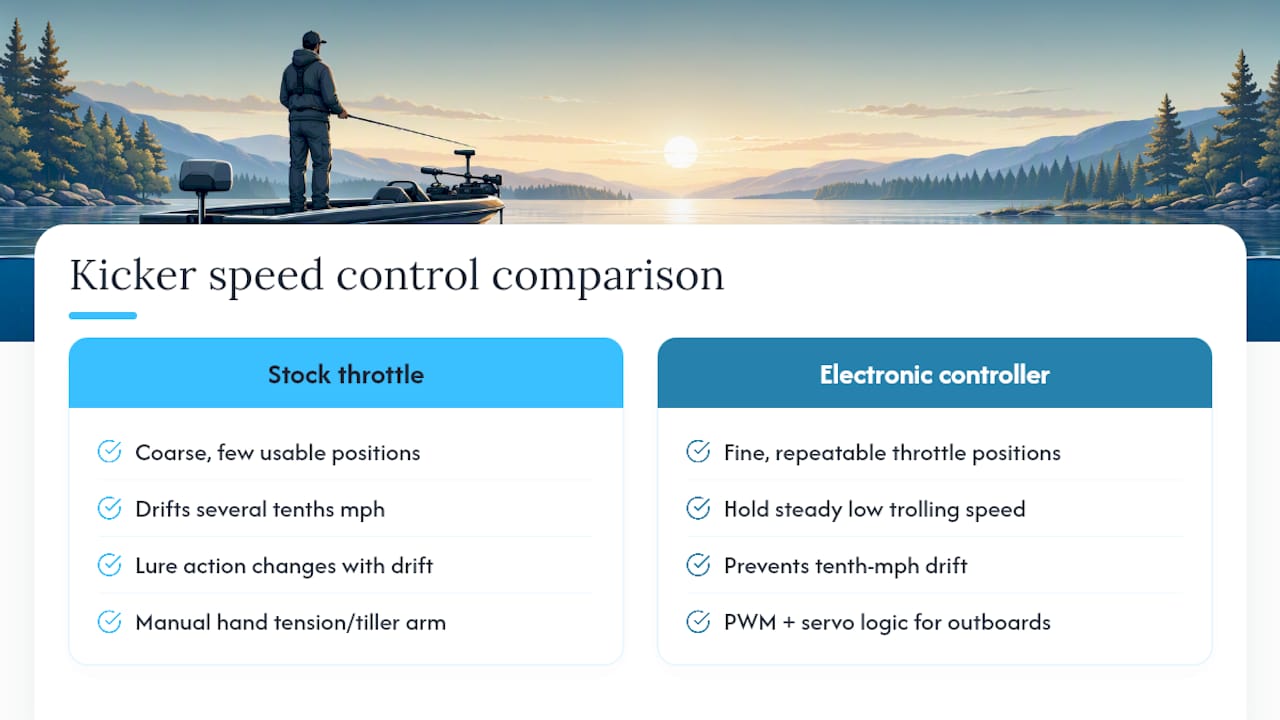
A stock kicker throttle gives you a handful of usable positions between idle and a fish-spooking crawl. That’s the real problem electronic controllers solve. Kicker motor speed control replaces coarse hand tension or a stiff tiller arm with fine, repeatable throttle positioning, so you can hold steady low trolling speeds instead of drifting several tenths of a mile per hour every time a wave rocks the boat. Anglers chasing salmon, steelhead, and kokanee live and die by that kind of consistency, because lure action changes the moment your trolling speed drifts even a tenth of a mile per hour off target.
The technology behind this isn’t new or exotic. It’s the same PWM and servo logic used across small-motor throttle regulation, adapted specifically for outboard cable-pull systems. What matters to you as a buyer isn’t the electronics theory, it’s which controller fits your motor, how many throttle positions it actually gives you, and whether it survives a season of spray, slime, and boat-ramp abuse.
Shortlist: Top Controller Models And What Each Does Best
Here’s how the leading options stack up for real fishing conditions, not just spec sheets.
-
Trollmaster Pro — A wired dial throttle built around motor-specific hardware kits, so installation follows a known fit rather than guesswork. It includes a momentary full-throttle burst button for quick repositioning and a water-resistant controller housing rated for long seasons on open water. Its extra-long cable run gives installers flexibility on mounting location, a real advantage on smaller boats with tight helm space, according to TrollMaster’s own product specs.
-
iTroll (G2.5 / G3 family) — The high-resolution end of the market. The iTroll lineup advertises roughly 1,000 throttle positions, adjustable servo travel, and waterproof servos built for saltwater exposure. Configurable “hunt” modes let you set a speed range and let the controller make micro-corrections automatically, which matters when tenths of an mph change how a spoon or flasher swims.
-
TAILFIN Kicker Steering System — The wireless option. It handles throttle and steering from a handheld remote, with adjustable turning sensitivity and universal-fit hardware that skips motor-specific kits entirely, per 180 Sails’ product listing. Great for anglers who move around the boat and don’t want to be tethered to a fixed control station.
-
Mercury ProKicker guidance — Mercury’s own kicker motor documentation is worth reading even if you’re not buying Mercury hardware, since it frames the industry-standard use cases (hover stroll, tandem trolling) that every aftermarket controller is designed to serve.
Typical pricing across wired dial and servo kits runs from budget-friendly basic units to premium high-resolution systems, with wireless steering setups generally landing at the higher end due to added remote and receiver hardware. Most are sold direct through manufacturer sites or specialty marine electronics dealers.
Wired Vs. Wireless: Which Control Type Fits Your Boat?
Every kicker speed controller reduces to three decision points: how it connects, how finely it adjusts, and how well it survives the elements.
- Control type determines your install complexity. Wired dial units run a cable from a helm-mounted controller to a servo at the motor. Wireless systems, like TAILFIN, replace that cable with a remote and receiver.
- Throttle resolution is the real differentiator in feel. A basic wired servo kit might offer dozens of usable steps; a high-resolution iTroll unit offers closer to a thousand.
- Compatibility and hardware kits matter more than any feature list. A controller with no fit chart for your motor is a controller you can’t install.
- Power and wiring needs are modest for most units, typically 12V, fused, and pulling only a few amps, but a wireless system adds a battery-powered remote to the equation.
- Weather resistance separates casual freshwater units from saltwater-rated servos and housings.
Before buying anything, confirm your motor’s cable-pull tension, mounting clearance at the helm, and whether your battery bank has a spare fused circuit available.
What Should You Check Before Ordering A Kit?
Getting the right kicker motor adjustment hardware comes down to three facts about your motor: make, horsepower, and model year. Get any one wrong and the linkage geometry won’t match.
- Pull your motor’s HP rating and year from the tag on the cowling, then match it against the manufacturer’s fit chart, since Trollmaster and iTroll both publish motor-specific kits rather than one universal bracket.
- Measure the distance from your intended helm mounting point to the motor’s throttle arm. Cable length matters more than people expect, and running a controller cable that’s too short forces an awkward mounting compromise.
- Confirm your linkage type, tiller arm versus remote-throttle cable, since that changes which bracket and servo arm you need.
- Decide your install path. A clean four-hour DIY job for a mechanically comfortable owner can stretch into a half-day project, or land better in a marine tech’s hands, if your dash routing is tight or your battery wiring needs upgrading.
Most kits ship with mounting hardware, cable, and a servo bracket. Warranty terms vary by brand, so check the listing before checkout rather than assuming full-motor-warranty coverage carries over.
Pro Tip: Order your hardware kit and controller together from the same listing whenever possible. Mixed-and-matched components from different sourcing runs are the single most common cause of installation-day surprises.
How Does A Throttle Controller Actually Control Speed?
Nearly every aftermarket kicker controller uses the same core method: pulse width modulation (PWM) driving a servo that pulls your motor’s throttle cable. PWM varies the duty cycle of an electrical signal to change average voltage or position a servo precisely, and that servo, not the engine’s ECU, is doing the physical work of holding your throttle plate steady.
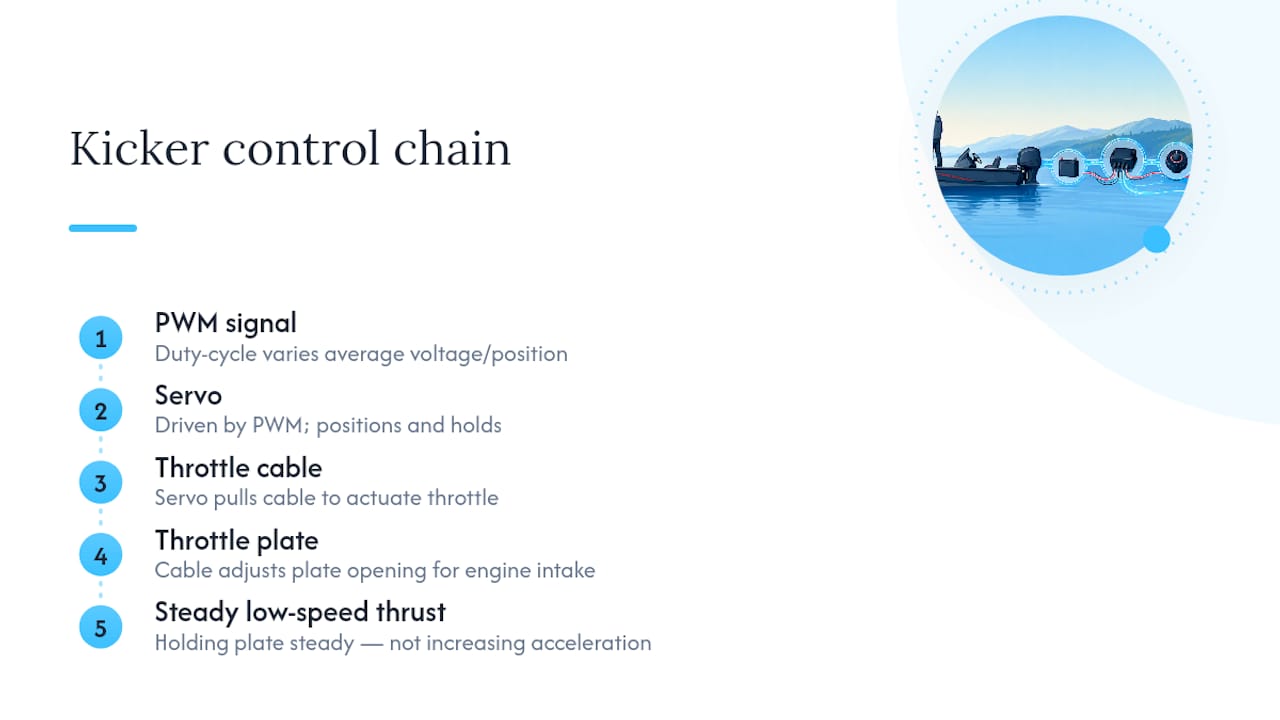
Here’s the part anglers often misunderstand: these controllers do not increase acceleration. Mercury Marine is explicit that a kicker controller’s job is steady low-speed thrust management, not 0-to-60 performance. A finer dial gives you smoother, more repeatable positioning, not a faster motor.
More advanced systems add closed-loop feedback, sensing actual servo position and correcting drift automatically. Consumer kicker units are simpler than the PID and field-oriented control loops used in industrial motor regulation, but the same principle applies at a smaller scale: feedback reduces the tiny throttle creep that shows up over a long troll.
Mounting, Power, And Compatibility Notes
Getting the wiring right matters as much as picking the right controller. A few field-tested basics:
- Match your linkage bracket to tiller or remote-throttle configuration, they are not interchangeable.
- Run a dedicated fused circuit; most controllers draw only a few amps, but sharing a circuit with other electronics invites voltage drop.
- Add a dual-battery isolator if your kicker shares a battery bank with your main engine or trolling electronics.
- Set servo travel limits during install so full-throttle burst doesn’t overshoot your motor’s mechanical stop.
- Check neutral safety and idle recall behavior before your first trip, not on the water.
Two Field Tips Most Anglers Skip
The tandem technique is worth mastering before you spend another dollar on electronics. Set your kicker slightly under your target trolling speed, by a small margin, then use a bow-mount electric motor to dial in the final number. This tandem approach gives you finer control in current than any single motor can offer.
Before buying any electronic system, check your existing throttle friction and steering co-pilot tension. Loose mechanical friction sometimes causes the exact instability anglers blame on “needing a controller.”
Pro Tip: After installation, run a calibration pass at idle and full extension before your first trip, confirming idle recall snaps back cleanly every time.
Why Repeatable Speed Changed How I Fish
I’ve watched a 0.2 mph difference turn a dead troll into a triple hookup. That’s not exaggeration, it’s how sensitive salmon and steelhead are to lure action. Controlled speed means your flasher spins the same way pass after pass, and that consistency is what actually produces repeatable strikes, not just smoother boat handling. Pair this with a solid read on current and river positioning and you’ll fish more water with confidence.
— Nick
Rig Up Right After You Dial In Your Speed
Once your kicker holds a rock-steady troll, your gear needs to match that precision. The lineup is built around exactly this moment, when a boat is finally running the speed needed and it’s time to make sure flashers, blades, and terminal tackle are pulling their weight too.

We’re not in the throttle controller business. We’re the crew that gets your terminal tackle screaming at whatever speed you’ve locked in. Check out our rigging and hardware accessories for the terminal gear that rounds out a properly tuned troll, or browse the North Wild Outdoors collection for flashers and blades built for West Coast salmon, steelhead, and kokanee runs. Get your controller installed, then get your rigs dialed in with us before your next trip.
FAQ
How Does A Motor Speed Controller Work?
It uses PWM to drive a servo motor that pulls your kicker’s throttle cable to a precise position, holding a steady RPM instead of letting the throttle drift with waves or hand pressure.
Does A Throttle Controller Increase 0-60 Acceleration?
No. Controllers are built for steady low-speed thrust management during trolling, not acceleration gains, and won’t make your kicker motor faster off the mark.
What Is The Point Of A Kicker Motor On A Boat?
A kicker motor is a small auxiliary outboard used for trolling and backup propulsion, giving you fuel-efficient, low-speed control that your main engine can’t match at idle.
Can I Troll With A Kicker Motor?
Yes, trolling is the primary use case for a kicker motor, and pairing it with an electronic speed controller makes holding a specific, repeatable trolling speed far easier than manual throttle adjustment.
0 comments