

Run a nearshore light setup under 100 feet, a standard 6 to 12 oz vertical cod-jig rig for 100 to 200 feet, a heavy setup for deep reef and ripping current, and a swimbait rig when the drift and depth let you work a retrieve. Each one matches a specific depth, current speed, and boat scenario. Full gear lists, rig recipes, and step-by-step tying instructions follow below.
TL;DR:
- Heavy jigging setups for deep reef fishing require 65 to 80 lb braid, an 80 to 100 lb leader, and a 16 oz jig with a dropper for best results.
- Lighter nearshore rigs use 30 lb braid and 3 to 5 oz jigs, as smaller lingcod in shallow waters respond well to less heavy gear.
- Proper line-to-depth matching is crucial, with line angles drifting away from vertical indicating the need for heavier jigs, especially in strong current.
- Using the correct cadence, such as drop-twitch or sweep-and-fall, significantly increases the likelihood of triggering strikes over different reef structures.
- Pre-tied leaders organized by depth and quickly swapped on the water improve efficiency and reduce missed fishing opportunities during prime bite windows.
Table of Contents
- The Four Lingcod Jigging Setups, Ready to Fish
- How Do You Choose the Right Rod, Reel, and Line?
- Which Jig Type, Weight, and Color Actually Catches Lingcod?
- How Do You Tie a Lingcod Jigging Rig Step by Step?
- How Should You Jig a Rig to Trigger a Strike?
- How Do Tides and Drift Affect Your Jigging Setup?
- Field Notes: Fast-Swap Rigs From High Class Tackle Co.
- What I’d Tell Any Angler Rigging Up for Their First Lingcod Trip
- Get Your Rig Parts Dialed Before the Next Trip
- Sources
The Four Lingcod Jigging Setups, Ready to Fish
You don’t need a truck full of rods to fish lings well. You need four setups, each built for a specific job, and the discipline to switch when conditions change. Here’s the exact recipe for each one.
Nearshore light setup (shallow structure, under 100 feet):
- Rod: 7 to 7.5 ft medium action, moderate tip for jig feel
- Reel: mid-size baitcaster or spinning reel with smooth drag
- Mainline: 30 lb braid
- Leader: 30 to 40 lb fluorocarbon, 3 to 5 feet
- Jig: moderate weight bar or diamond jig, single hook -Pro Tip: Nearshore lings tend to run smaller than deep-reef fish, so lighter gear here isn’t a compromise. It’s the smarter tool for the job. This range comes straight from proven light-tackle tactics built around 30 lb braid and low single-digit ounce weights.
Standard vertical jigging setup (100 to 200 feet, moderate drift):
- Rod: 7.5 to 8 ft medium-heavy, fast action with real backbone
- Reel: high-speed conventional reel, 5.4:1 or faster retrieve
- Mainline: 50 to 65 lb braid
- Leader: 60 to 80 lb fluorocarbon, 4 to 6 feet
- Jig: medium weight metal bar jig or diamond jig with a soft-plastic trailer -Pro Tip: This is your bread-and-butter rig for classic reef structure. Weight guidance here lines up with standard bar-jig sizing for 100 to 200 ft reef, and it’s the rig most PNW boats run 80% of the day.
Deep or offshore heavy setup (200+ feet, ripping current, structure with teeth):
- Rod: 8 ft heavy, stout backbone to horse a big ling off the bottom
- Reel: large conventional reel with high line capacity
- Mainline: 65 to 80 lb braid
- Leader: 80 to 100 lb fluorocarbon, 5 to 6 feet
- Jig: heavy jig, often paired with an 18-inch dropper carrying cut bait or a soft-plastic teaser -Pro Tip: Don’t undersize this jig to save your arms. A jig that drifts sideways in strong current never reaches bottom cleanly, and lings live on the bottom. The dropper pairing here matches productive two-fish jig-and-teaser rigs that PNW reef anglers run for mixed rockfish and lingcod bites.
Swimbait / pull setup (retrieve-friendly drift, aggressive fish):
- Rod: 7.5 ft medium-heavy, moderate-fast for absorbing a hard strike
- Reel: conventional or heavy spinning reel with a strong drag
- Mainline: 50 to 65 lb braid
- Leader: 60 to 80 lb fluorocarbon, 4 to 5 feet
- Jig: leadhead with a 7 to 10 inch paddle-tail swimbait, trap or assist hook -Pro Tip: Keep reeling through the bite. Don’t swing. This aligns with guidance on swimbait leadheads and trap hooks for trophy lingcod.
Snag risk climbs fast with every setup once you’re tight to structure, which is exactly where lings live. Nearshore and standard rigs are the easiest to break free with a sharp rod-tip snap. Heavy deep rigs and dropper setups snag harder and more often, so carry extra pre-tied leaders and be ready to cut off rather than lose a whole drift fighting a rock.
How Do You Choose the Right Rod, Reel, and Line?
Rod backbone is what actually gets a lingcod off the bottom before it wraps you around a boulder. These fish don’t run, they dig, and a soft rod tip means you’re fighting the fish and the reef at the same time.
Rod length and action by setup
For nearshore work under 100 feet, a 7 to 7.5 ft medium action rod gives you enough tip feel to detect subtle bites without overpowering smaller fish. Once you move to standard 100 to 200 foot vertical jigging, step up to a 7.5 to 8 ft medium-heavy fast-action rod. The extra length helps you sweep the jig through a longer arc, and the fast action gives you a hard, immediate hookset. Deep and heavy structure setups demand an 8 ft heavy rod with serious lifting power. This is not the place to save weight or flex. When a 30-lb-plus ling buries itself in a rock pile 220 feet down, a soft rod just bends and loses the fight before it starts.
Reel choice and drag
Conventional reels dominate serious lingcod jigging because they handle heavier braid, offer better line capacity, and give you direct cranking power on the retrieve. A mid-size conventional with a 5.4:1 or faster gear ratio keeps you from falling behind on hooksets in deep water. Set your drag at roughly a third of your leader’s breaking strength as a starting point, then adjust once a fish is hooked and pulling hard toward structure.
Mainline and leader specs
Braid does the sensitivity work here. For nearshore setups, 30 lb braid is plenty. Standard vertical rigs run best on 50 to 65 lb braid, which resists abrasion against rock edges better than lighter line while still transmitting the tap of a bite. Deep and heavy setups need 65 to 80 lb braid, both for abrasion resistance and for the raw lifting power to control a big fish on a long drop.
Leader material should always be fluorocarbon, not straight braid to hook, because fluoro resists nicks from barnacles and rough bottom far better. Leader length runs 3 to 6 feet depending on setup, tied with an FG knot connecting braid to leader for a low-profile connection that runs cleanly through rod guides. If you’re not confident tying an FG knot on a rocking boat, a double uni knot is a reliable backup, and a uni-to-uni connection works fine for quick leader swaps in a hurry.
Two real-world examples
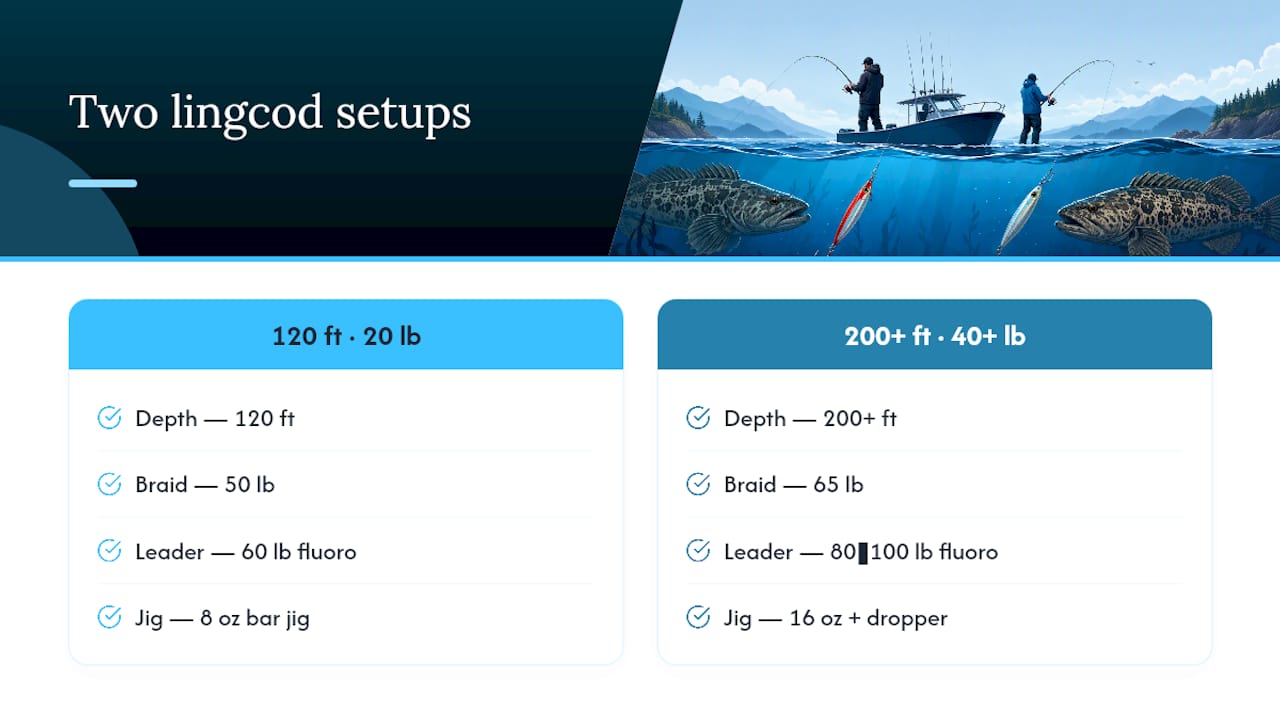
For a 20-lb ling on structure around 120 feet, run 50 lb braid, a 60 lb fluoro leader, an 8 oz bar jig, and set your drag around 8 to 10 lbs. For a 40-lb-plus ling on deep reef past 200 feet, step up to 65 lb braid, an 80 to 100 lb leader, a 16 oz jig with a dropper, and push drag closer to 15 to 18 lbs. That heavier drag setting matters. A 30-inch lingcod is already a mature fish often 3 to 5 years old, and anything pushing 40 lbs is a genuine trophy that will test every knot in your rig.
Which Jig Type, Weight, and Color Actually Catches Lingcod?
The right jig comes down to two questions: how fast does it need to fall, and how visible does it need to be. Get those two right and the species mostly takes care of itself.
- Metal bar jigs fall fast and flutter erratically on the drop, which mimics an injured baitfish tumbling toward the bottom. This is the workhorse profile for standard 100 to 200 foot reef fishing.
- Diamond jigs cut through current with a tighter, faster fall than bar jigs, making them a strong pick when drift speed picks up and you need to stay vertical.
- Copper pipe jigs have a slower, wobblier fall and shine in clearer water where a subtler flash outperforms a violent flutter.
- Banana jigs ride at an angle on the drop, giving a gliding action that covers more lateral ground, useful when fish are scattered across a wider patch of structure.
- Lead-head swimbaits with paddle-tail trailers work when drift speed allows an actual retrieve rather than pure vertical jigging, giving lings a long, swimming profile to commit to.
Matching weight to depth is mostly about keeping the jig vertical, not hitting a specific number. In under 100 feet with light current, 3 to 10 oz keeps you connected to bottom without overpowering the rod. From 100 to 200 feet, 6 to 12 oz is the standard range, and that guidance holds up across most Pacific Coast reef fishing. Past 200 feet, or in current that’s dragging your line at an angle, jump to heavy weight. If your line angle drifts noticeably away from straight down, you’re underweighted, period. Add weight until you’re vertical again.
Color follows water clarity more than any fixed rule. White and chrome imitate baitfish and work well in clear water and bright light. Chartreuse stands out in murky or green water and on overcast days. Glow jigs earn their keep in deep, low-light conditions past 150 feet, or on gray PNW days when the light just doesn’t punch through. If you’ve made a dozen drops with no interest, change color before you change spots. It’s the cheapest adjustment you can make.
Trailers and hook choice matter more than anglers give them credit for. A soft-plastic curly-tail or paddle-tail trailer adds bulk and movement that a bare metal jig can’t replicate, and it often turns a look into a strike. Pair trailers with a single strong hook sized to the jig, and step up to an assist or trap hook on swimbait rigs where a fish can miss a straight hook shank on a fast strike, a detail confirmed by swimbait-specific rigging for big lingcod. For more on matching head weight to hook style, our breakdown of jig head types and weights covers the hardware side in more depth.
How Do You Tie a Lingcod Jigging Rig Step by Step?
Tying on the water beats tying at the dock, but only if you’ve practiced the knots first. Here’s how to build all three common rig styles.
Single jig rig (materials: main jig, 4 to 6 ft fluoro leader, swivel, FG or uni-to-uni knot)
- Tie your braid to a small ball-bearing swivel using an FG knot or a strong double uni.
- Attach 4 to 6 feet of fluorocarbon leader to the swivel’s other eye with a uni knot.
- Tie the jig directly to the leader’s terminal end with a uni or Palomar knot, leaving enough tag to trim clean.
- Check the jig hangs straight and doesn’t spin the leader when dropped alongside the boat.
Jig plus dropper/teaser rig (materials: main jig, dropper hook, 18-inch dropper leader, cut bait or soft-plastic teaser)
- Build the single jig rig above as your base.
- About 18 inches above the main jig, tie in a dropper loop or a second swivel using a uni-to-uni connection.
- Attach a short 6 to 8 inch leader off that dropper point, ending in a dropper hook.
- Bait the dropper hook with cut bait or a small soft-plastic teaser, matching the setup used in productive dropper rigs for mixed reef species.
Live or cut-bait bottom rig (materials: sliding sinker, bead, swivel, 3 to 4 ft leader, circle or J hook)
- Thread your mainline through a sliding sinker and a plastic bead to protect the knot.
- Tie the mainline to a swivel using a uni knot.
- Attach a 3 to 4 foot fluoro leader to the swivel, then tie on a circle hook for live bait or a J hook for cut bait.
- Bait up and lower to bottom, keeping enough slack to let the sinker settle before the bait.
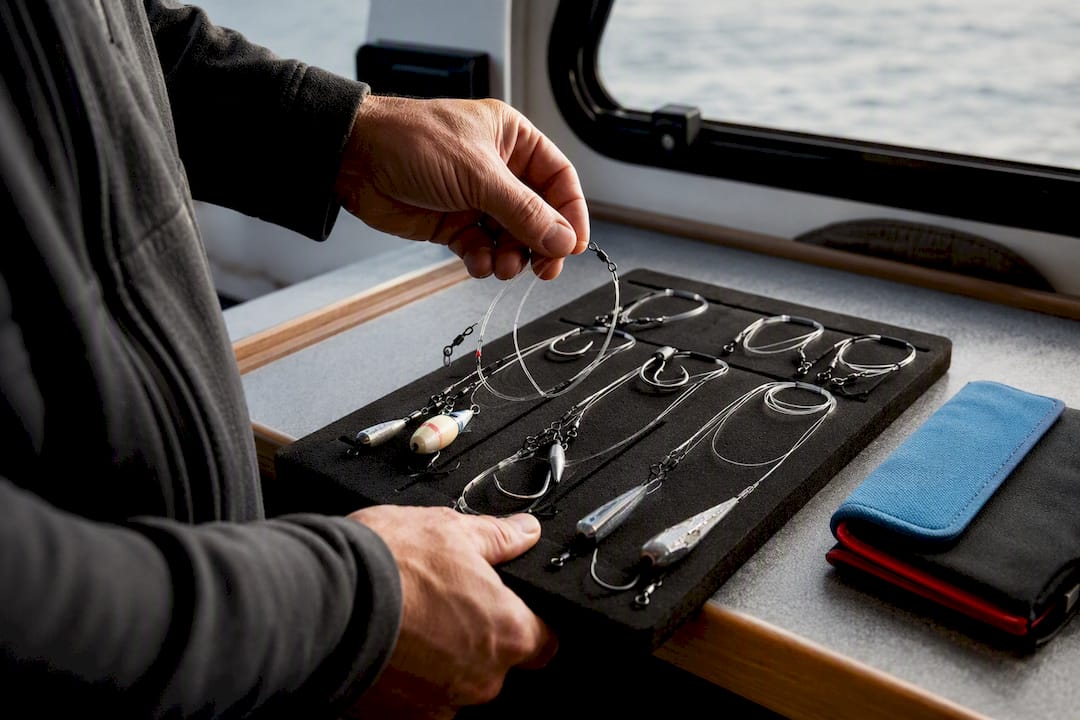
Pre-tied leader pack system
Tie a batch of leaders at home in your common weight and length combinations, then label each one on a small tag with weight, jig type, and length. Store them looped on foam leader boards or in a compartmented leader wallet, organized by depth range. When conditions shift on the water, you swap the whole leader and jig assembly instead of retying blind on a rocking deck, a workflow that keeps you fishing instead of fumbling with cold, wet fingers.
Troubleshooting common failures: a jig that keeps spinning usually means your leader is too long or your knot isn’t centered. A dropper that tangles around the main line means your dropper leader is too short relative to current speed, so lengthen it. If you’re getting bit off clean, you’re using leader that’s too light for the structure, so size up before you lose another jig to a rock.
Pro Tip: Carry at least three pre-tied leader lengths and two leader-strength options in your pack at all times. Current changes fast on a moving tide, and re-rigging from scratch costs you the drift you’re already on.
How Should You Jig a Rig to Trigger a Strike?
Getting to bottom is step one, and confirming you’re actually there matters more than most anglers admit. Drop your jig on a controlled fall, thumb the spool lightly, and count the seconds until you feel the telltale mushy stop of bottom contact. Cross-check that against your fish finder’s depth reading. If your count and your sounder don’t agree, you’ve drifted off your mark or your jig is getting pushed by current.
Once you’re on bottom, work one of three cadence templates depending on mood and structure:
- Drop-twitch: lift the rod tip 2 to 3 feet, twitch it sharply twice, then let the jig fall back on slack line. Repeat. This is your default for most reef structure.
- Sweep-and-fall: raise the rod in a long, slow sweep to the side, then drop it fast, letting the jig flutter down erratically. Strong producer when fish are aggressive but scattered.
- Rapid flutter: short, fast rod pumps near bottom that keep the jig in a tight zone without a big rise. Effective over small, defined pinnacles where you don’t want to jig off the spot.
Erratic, high-profile movement that mimics wounded prey consistently outperforms slow, finesse presentations for lingcod, a pattern backed by reef-specific lingcod behavior research.
Hooksets differ sharply between jigs and swimbaits, and mixing up the two costs fish. On a straight metal jig, set hard and immediately when you feel weight, since lings hit fast and can spit a jig quickly. On a swimbait, resist the instinct to swing. Keep reeling through the bite until the rod loads under real weight, then apply steady pressure. Swinging early on a swimbait often pulls the trap hook right out of a fish’s mouth before it’s fully committed.
Fast drift changes everything. If your jig starts trailing at an angle instead of running vertical, you’re either underweighted or the drift has outpaced your presentation. Switch to a heavier jig first. If that doesn’t fix your angle, consider changing to a bottom bait rig that holds position better in a hard-running current than a jig ever will.
How Do Tides and Drift Affect Your Jigging Setup?
Jig weight and current speed are directly linked, and getting this wrong is the single most common reason anglers strike out on lings that are clearly there on the sounder. If your line angle isn’t close to straight down, add weight until it is. There’s no fixed formula because bottom type, boat drift speed, and current all interact, but the rule holds everywhere on the coast: heavier current demands heavier jigs, full stop.
- Slack tide often produces the calmest, most controlled jigging, letting you use lighter jigs and slower cadences.
- Moving water, whether flood or ebb, tends to trigger more aggressive feeding as bait gets pushed around structure, which is exactly when lingcod turn on.
- Fishing straight through a tide change usually beats waiting it out, since the transition itself often produces the best bite window of the day.
Boat control matters as much as gear choice. Pace your drift so the boat covers structure at a speed your jig weight can actually keep up with, and use engine trim or a drift sock to slow down over prime pinnacles. Approach structure at an angle that lets you fish the up-current edge first, since that’s typically where lings stage to ambush bait pushed toward them.
When you’re snagged, and you will be, don’t horse it blind. Point the rod straight at the snag, apply steady pressure, and try walking the boat slightly off the mark to change your pull angle before you commit to breaking off. If it’s not coming free after two or three angle changes, cut the leader above the snag rather than risk losing your whole rig or damaging your rod tip fighting a rock.
Field Notes: Fast-Swap Rigs From High Class Tackle Co.
Real days on the water don’t wait for perfect knots, so the leader system you bring matters as much as the jig you tie on. Nick built a rotation of pre-tied leaders that gets swapped in seconds, not minutes, and it’s changed how our crew fishes structure.
- Leaders get labeled by weight and jig type on small tags, stored on a foam board sorted by depth range.
- A typical deep-reef day rig ran 65 lb braid, an 80 lb fluoro leader, and a 16 oz jig with an 18-inch dropper for mixed lingcod and rockfish over broken rock past 180 feet.
- A calmer nearshore morning called for 30 lb braid, a 40 lb leader, and a 6 oz bar jig worked over scattered boulder fields under 80 feet.
- Drag stayed locked around a third of leader strength until a big fish committed, then got bumped up gradually as the fight moved away from structure.
- Swapping leaders takes under 10 seconds once you’ve practiced it a few times at the dock, which matters when fish are stacked on the sounder and every second on bottom counts.
What I’d Tell Any Angler Rigging Up for Their First Lingcod Trip
Every rig recipe in this guide is a starting point, not a rulebook. The best lingcod anglers I know still change jig weight, color, or cadence three or four times on a slow day before they find what the fish actually want that morning. Treat your first few trips as practice for reading your own line angle and bottom feel, because that instinct is worth more than any single jig in your box. Before you keep anything, confirm the species and check your local size and bag limits, since lingcod regulations vary by zone and season along the coast.
— Nick
Get Your Rig Parts Dialed Before the Next Trip
Terminal gear that matches every rig in this guide is available to avoid stitching together parts from different brands and hoping the hardware holds up on a 200-foot drop. Our terminal tackle and components collection covers the hooks, swivels, and crimps you need for single jig, dropper, and bottom rigs alike, sized right for lingcod instead of generic saltwater use.
If you’re building a swimbait setup, our custom superbaits and swimfish collection gives you paddle-tail trailers built with the same durability standard we hold our salmon and steelhead gear to. Head to the Highclasstackleco shop, pick your setup from this guide, and get your leader packs tied before your next reef trip, not the night before.
Sources
- Alaska Department of Fish and Game — Lingcod
- How to Catch Lingcod — Complete Pacific Coast Fishing Guide
- Lingcod and Rockfish — Pacific Reef Bottom Tactics
- Catching Lingcod on Light Tackle — Saltwater Sportsman
- Using swim baits to catch big California lingcod — Sport Fishing Magazine
0 comments