

Stop line twist before it starts by spooling with light, even tension, and stopping 1/8 to 1/4 inch below the spool lip, running a properly sized ball-bearing swivel with a short mono or fluoro leader on braid, and matching your trolling speed to what the lure actually wants. If twist shows up anyway, kill the reel, feed line out behind the boat, and let it relax. This guide walks through the rigging, the spooling steps, the diagnosis, and the untwist routine, including a couple of tricks straight from real boat time and gear designed to track true instead of spin.
TL;DR:
- Using a correctly sized ball-bearing swivel with a short leader and matching the lure’s speed to water conditions significantly reduces line twist during trolling.
- Proper spooling technique, such as winding with even tension and filling only within 1/8 to 1/4 inch of the spool lip, prevents line memory and coil buildup.
- Reacting quickly to twist signs by stopping the reel and feeding line out behind the boat helps naturally untwist line without damaging hardware.
- Selecting hardware like downrigger clips over inline weights and running braid with a short mono or fluoro leader minimizes twist caused by gear design and water resistance.
- Conducting pre-trip checks, such as testing lure tracking at different speeds and inspecting reel rollers, helps identify and prevent twist causes before fishing begins.
Table of Contents
- Quick Fixes to Stop Line Twist Trolling Mid-Trip
- Rigging and Tackle Choices That Cut Down on Twist
- How Should You Spool Your Reel to Avoid Twist?
- Why Is Your Line Twisting? Diagnosing the Real Cause
- Untwisting a Badly Twisted Spool: Boat and Shore Methods
- Field Notes: A Pre-Departure Habit That Actually Works
- What Anglers Get Wrong About Line Twist
- Gear That Backs Up Every Fix in This Guide
- Sources
- FAQ
Quick Fixes to Stop Line Twist Trolling Mid-Trip
Twist shows up fast when you’re trolling, and how you react in the first 30 seconds matters more than anything you do later at the dock.
The first move is the simplest one: stop reeling. Winding against line that’s paying out just cranks in more twist, one turn at a time. Ease the drag, let the fish or current pull line off freely, and resist the urge to “help” by cranking.
- Kill the reel handle the moment you notice the rod tip doing something weird or the line bunching into little curls.
- Strip off any terminal tackle so nothing is spinning at the end of the line.
- Feed the bare line out behind the moving boat, 50 to 100 feet at a time, letting the boat towing motion untwist the line naturally.
- Pause 2 to 5 minutes at each increment, then do a short test pull straight toward the rod tip to feel for leftover coils.
- Repeat the payout and test cycle until the line comes back clean.
If you’re mid-bite and can’t spare five minutes, two field tricks buy you time: the pinch-and-reel method (pinch the line ahead of the reel and strip a few feet by hand before winding, which breaks the twist cycle) or swapping the offending lure for something that doesn’t spin, like a plug instead of a spinning blade.
Pro Tip: Keep a spare ball-bearing swivel pre-tied to a leader in your tackle box. Clipping in a fresh one on the water solves half of all sudden twist problems in under a minute.
Rigging and Tackle Choices That Cut Down on Twist
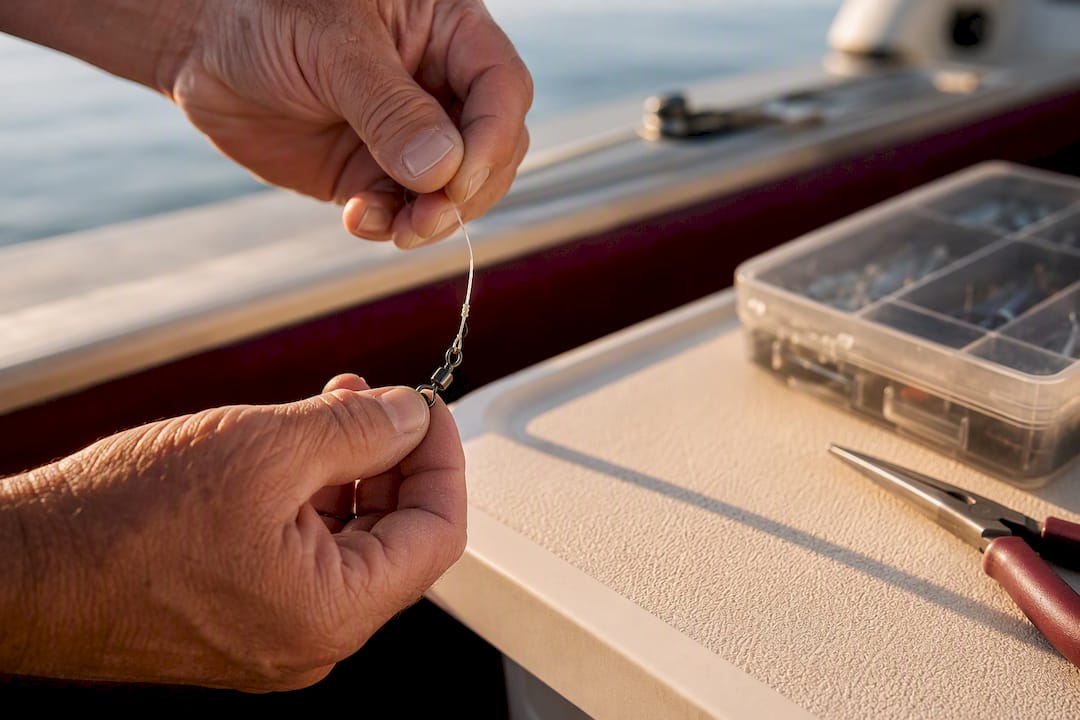
Your hardware decides how much twist you’re fighting before you ever hit the water. A cheap barrel swivel on the wrong size leader is basically decorative. It spins along with the lure instead of absorbing the rotation.
- Match swivel size to leader diameter. An undersized ball-bearing swivel doesn’t have enough resistance to actually turn and release torque, so it locks up and passes the spin straight to your mainline.
- Run braid with a short leader. Braid main line paired with a 3 to 6 foot mono or fluoro leader gives you the low stretch and thin diameter of braid with the shock absorption of monofilament right where the lure is doing its dirty work.
- Tie braid-to-leader with a Double Uni or Palomar knot. Both hold well across the diameter jump and won’t slip under trolling load, and pairing that with a mono or fluoro backing under the braid keeps the braid from spinning loose on the spool arbor.
- Choose downrigger clips over running weights when spin is a recurring problem. A release clip keeps the weight independent of the lure’s action, while an inline running weight can amplify rotation straight up the line.
- Run a conventional or trolling-style reel when you can. A level-wind or conventional setup naturally resists twist better than a spinning reel matched to gear it wasn’t built for.
Pro Tip: If you’re stuck running a spinning reel for trolling, add one extra ball-bearing swivel between your leader and your main line. It costs you almost nothing in casting distance and buys you real insurance against spin.
Check out our types of fishing swivels and terminal gear guide for sizing charts before you rig up.
How Should You Spool Your Reel to Avoid Twist?
Bad spooling is the twist you bring with you before the boat even leaves the dock. Line that goes on with uneven tension stores that stress as memory, and memory shows up as twist the moment you put it under load again.
- Set the new spool on the floor or have someone hold a pencil through it so line feeds off the same way it’s wound on the reel, matching the curve of the spool to the curve of the line coming off the factory spool.
- Run the line through a folded damp cloth pinched lightly between your fingers as you wind, giving it steady, even resistance the whole way.
- Stop filling once you’re within 1/8 to 1/4 inch of the spool lip. Overfilling causes wraps to slip and pile up, and an underfilled spool costs you casting distance and adds friction that fights your drag setting.
- Before every trip, spin the bail and line roller by hand. A seized roller is one of the most common hidden causes of twist nobody checks until it’s too late.
- Rinse reels in fresh water after every saltwater trip and inspect guides for burrs that can catch and twist line as it passes through.
Braid resists memory-related twist far better than monofilament, which is one reason so many trollers have shifted to braid-plus-leader setups. If your mono or fluoro has been sitting on the reel for a full season and shows tight coils fresh off the spool, that’s stored memory talking. Replace it rather than fighting it all season.
Why Is Your Line Twisting? Diagnosing the Real Cause
Most line twist traces back to one of three things: the wrong speed, bad hardware, or a rigging mismatch. Figuring out which one you’re dealing with takes about two minutes and saves you from guessing all afternoon.
- Drop the lure in the water right next to the boat before you send out a full spread, and watch it. A lure running at the correct speed wobbles. One running too fast starts to spin, and that spin transfers straight up the line.
- Watch the rod tip. Steady nodding usually means the lure is tracking correctly, while a sudden change in that nodding pattern often signals weeds, debris, or a lure that’s started to spin out.
- Check the reel itself: a bent bail, a seized line roller, or spool misalignment can all introduce twist that has nothing to do with your lure or leader.
- Isolate the variable. Swap the lure, then swap the leader and swivel, then swap the reel if you have a spare, testing each change on its own until the twist disappears.
Once you find the speed where wobble replaces spin, that’s your lure’s real trolling window, and it’s worth writing down for next time.
Untwisting a Badly Twisted Spool: Boat and Shore Methods
A spool full of coiled line doesn’t need a trip to the shop. It needs a few minutes and a method that matches where you are.
- From the boat: strip off all terminal tackle, feed the bare line out 50 to 100 feet behind the boat, and run at a normal trolling speed for several minutes to let the rotation work itself out behind the hull.
- Retrieve slowly, testing every 20 to 30 feet with a short pull to check for remaining coils.
- From shore: tie a swivel to a fixed point like a dock post, clip your line to it, and walk backward feeding out line until the twist visibly relaxes, then wind back in under light tension.
- Watch your footing near current, boat traffic, and other anglers’ lines while you do this. A shoreline untwist can turn into a tangle with someone else’s gear fast.
- If a spool is twisted badly enough that untwisting keeps failing, cut out the worst section and re-spool fresh rather than fighting line that’s permanently kinked.
Pro Tip: Never wind line onto the reel while it’s still twisted just to “deal with it later.” You’re storing the problem for your next trip, not solving it.
Field Notes: A Pre-Departure Habit That Actually Works
Nick runs the same 90 second check before every High Class Tackle Co. test session: spin the line roller, tug the swivel to confirm it’s ball-bearing and correctly sized, measure the leader at 3 to 6 feet, and drop one lure next to the boat to watch it track before running the full spread.
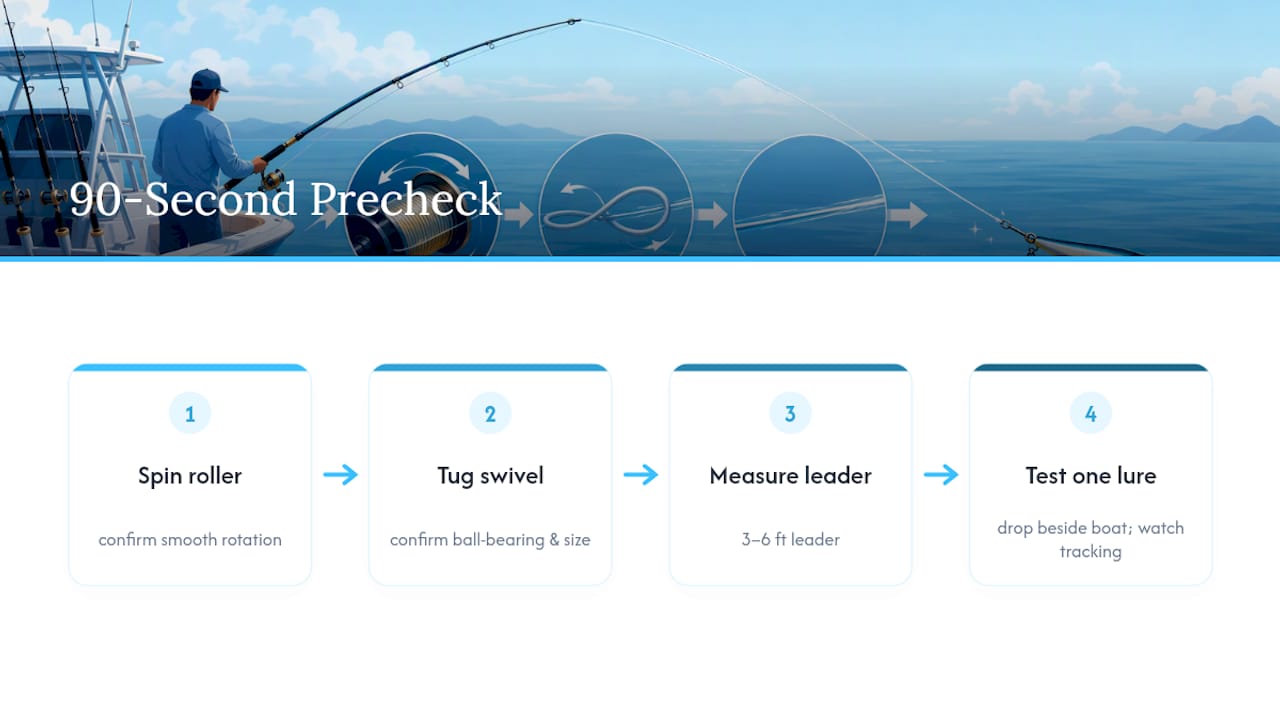
That last step catches more problems than any piece of hardware. A lure that spins at idle speed but wobbles at trolling speed is telling you something real about where its window actually sits. Watch the rod tip for its normal nod, and if that rhythm changes mid-troll, reel up and check before you keep running. Test every lure in a new spread individually. It takes an extra five minutes and saves you from untangling four lines at once later.
What Anglers Get Wrong About Line Twist
Most anglers treat line twist as bad luck. It’s not. It’s almost always a chain of small, fixable decisions: a spool filled under uneven tension, a swivel sized for looks instead of function, a lure run at whatever speed felt right instead of the speed it was actually built for.
The conventional advice leans hard on gear upgrades, telling you to buy a better swivel and call it solved. That’s backwards. A $2 mismatch between swivel size and leader diameter will out-twist a $30 swivel every time if the lure itself is running too fast. Speed is the variable nobody checks first, and it’s the one that costs nothing to fix.
If there’s one thing worth prioritizing over everything else in this guide, it’s the 30 second lure-speed test before you drop a full spread. Everything else, from spooling technique to leader length, matters less if the lure is fighting the water at the wrong speed to begin with. Get that right, and most twist problems never show up in the first place.
— Nick
Gear That Backs Up Every Fix in This Guide
Good technique only goes as far as the hardware behind it. Some specialized trolling rods are designed to track true at speed instead of hunting and spinning, which solves the exact problem this whole guide is about before you ever touch a swivel.

Pair it with quality gear from our terminal tackle and components collection for correctly sized ball-bearing swivels and beads, and check the flashers and bumpers lineup if your lure has been hunting instead of tracking straight. Running a downrigger setup instead of an inline weight to control spin? Our weights collection covers clips and hardware sized for real Pacific Northwest trolling conditions. Browse the full lineup at High Class Tackle Co. and start swapping out whatever’s been causing your twist problems all season.
Sources
For deeper technical detail, see the Coastfish trolling handbook on spooling, Backcountry Cariboo and Baithook Vault on quick fixes, and HandingFishing on spooling and leader technique.
- Preparing trolling lines — Coastfish Trolling handbook
- Tangled Fishing Line: How To Eliminate Tangles While Trolling – Backcountry Cariboo
- Quick guide to remove line twist — Trout Resource
FAQ
How Do You Avoid Line Twist While Trolling?
Spool with light, even tension, stopping 1/8 to 1/4 inch below the lip, and run a correctly sized ball-bearing swivel with a short mono or fluoro leader on braid. Test each lure’s trolling speed next to the boat before running a full spread, since a lure fighting the water at the wrong speed is the single most common cause of twist.
Why Does My Fishing Line Keep Getting Twisted?
Most twist traces back to a lure running too fast for its design, a mismatched or undersized swivel, or winding the reel while line is actively paying out. Bad spooling tension from a previous session can also store memory in the line that shows up as twist later.
How Do You Stop Fishing Line From Coiling?
Coiling usually means the line has stored memory from uneven spooling tension or has sat too long on the reel. Re-spool with a damp cloth for even tension, stop just below the spool lip, and replace mono or fluoro that shows tight coils fresh off the reel.
How Do You Stop Braid From Spinning on the Spool?
Spool braid over a mono or fluoro backing so it grips the arbor instead of slipping, and tie the connection with a Double Uni knot for a secure hold under trolling load. A loose or underfilled spool makes braid slippage worse, so keep fill level consistent right up to that 1/8 to 1/4 inch mark below the lip.
0 comments