

Reading steelhead holding water is the process of identifying specific river spots where steelhead conserve energy, rest, and stage before migrating or feeding. Steelhead do not distribute randomly across a river. They seek out walking-pace currents at depths of 4–6 feet, hydraulic dead zones behind boulders, and soft seams along inside bends. Anglers who understand these features catch fish. Anglers who wade in blind do not. This guide breaks down the river science and practical steelhead fishing techniques you need to find fish fast, whether you are swinging flies on a coastal river or drifting bait through a winter run.
What key river features indicate steelhead holding water?
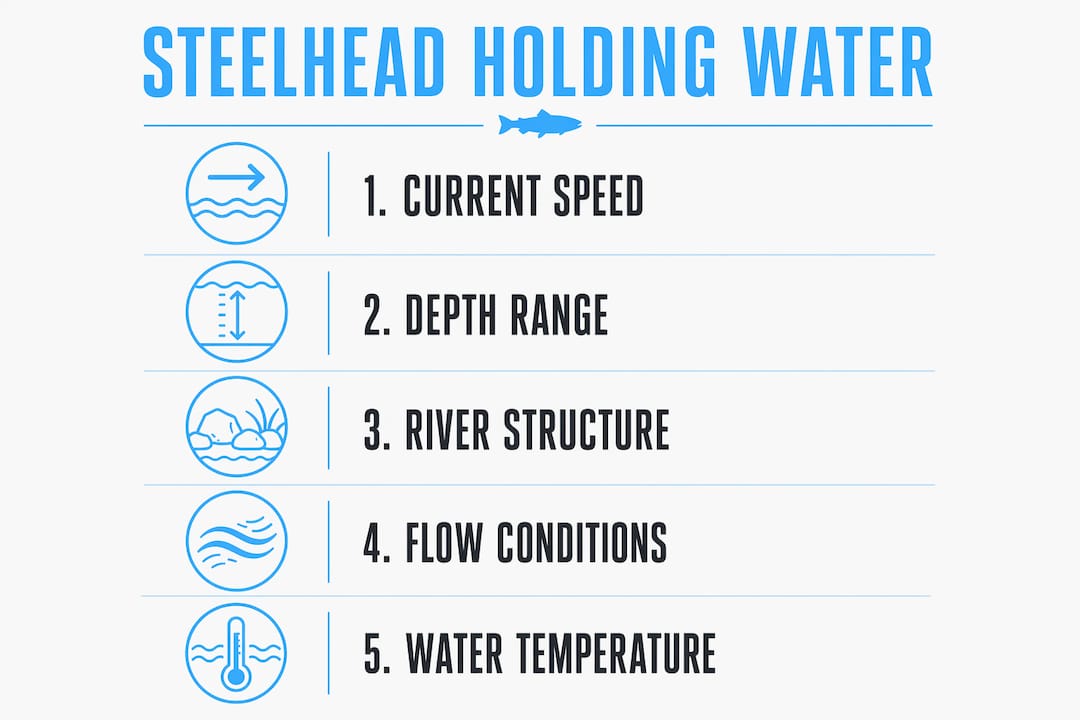
Steelhead holding water is defined by current speed, depth, and structure. The fish are not looking for the fastest water or the deepest pool. They want a spot where they burn minimal energy while staying oxygenated and safe.
The single most reliable indicator is current speed. Optimal holding depth sits at 4–6 feet with a walking-pace current, measured as 2–4 seconds for a floating object to travel 10 feet. That pace is slow enough to rest in but fast enough to deliver oxygen and food. Anything faster pushes fish out; anything slower and they lose the current advantage.
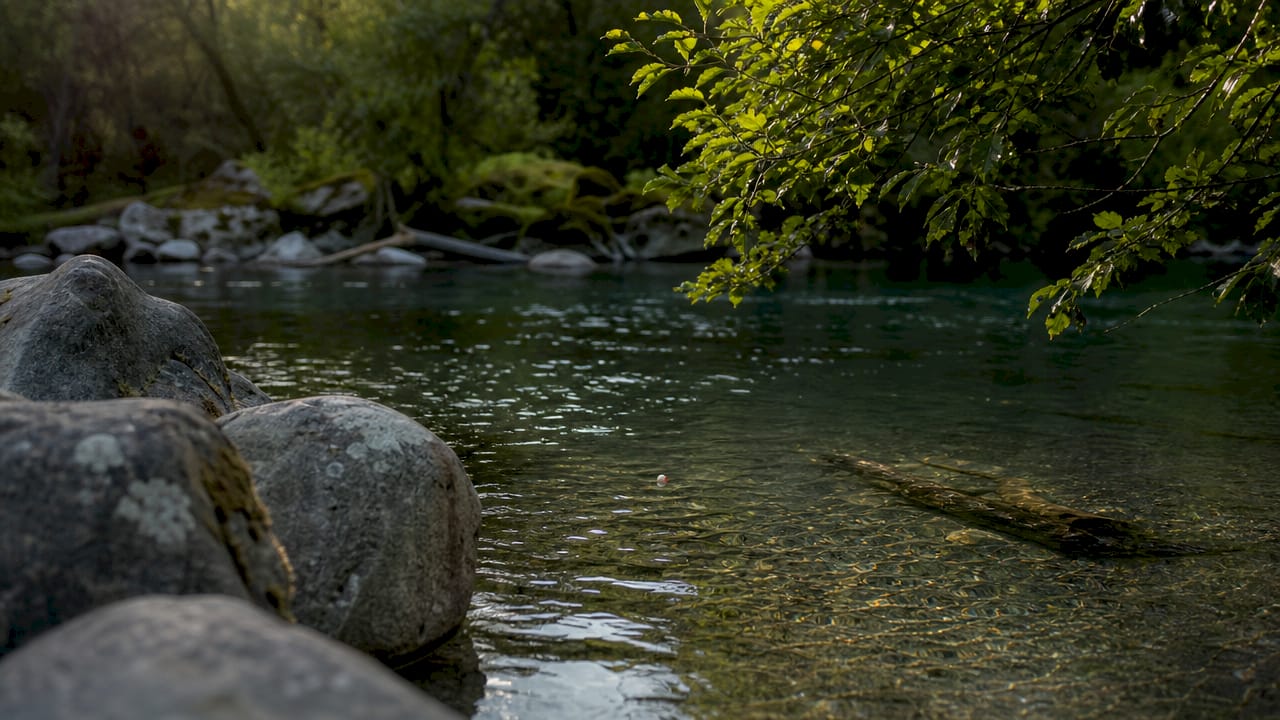
Structure creates the second key condition. Hydraulic dead zones form downstream of boulders, submerged ledges, and rock shelves where near-zero velocity pockets sit directly behind the obstruction. Steelhead park in these shadows and let the main current do the work. The mistake most anglers make is casting right at the boulder. The fish are sitting 3–8 feet behind it, not beside it.
Surface reading is your fastest scouting tool. Look for these visual cues:
- Foam lines: Foam collects along current seams where fast and slow water meet. Steelhead hold just inside the slow side.
- V-wakes: A subtle downstream V on the surface signals a submerged object creating a hydraulic shadow below.
- Color changes: Darker water indicates depth. A sudden shift from light green to dark teal often marks a drop into a holding seam.
- Inside bends: The inside of a river bend always has slower current and softer bottom. These are reliable holding spots year-round.
- Tailouts: The shallow, glassy tail end of a pool is where steelhead stage before moving. Do not skip tailouts.
Pro Tip: Carry a small foam indicator or a leaf and toss it into water you are scouting. Count the seconds it takes to travel 10 feet. If it floats through in 2–4 seconds, you are looking at prime holding water.
How to identify steelhead holding water during different river flow conditions
River flow changes everything. A run that holds fish at normal flows may be completely empty at flood stage, and vice versa. Learning to adjust your reading based on conditions separates consistent anglers from one-trip wonders.
High water conditions compress fish into a narrow strip along the bank. Steelhead move within 10–15 feet of the bank during high flows, using root wads, overhanging brush, and vegetated margins as shelter from the main current. This is counterintuitive for anglers trained to fish the middle of the river. When the river blows out, walk the bank edges and fish tight to cover.
Low and clear water conditions push fish deeper and make them spooky. Steelhead drop into the deepest available seams and become far more sensitive to movement and shadow. Your approach matters as much as your presentation in these conditions.
Here is a step-by-step process for reading flow conditions on any river:
- Check water clarity first. Clarity is a better fishability indicator than river height. A river can be running high and still be fishable if you can see 12–18 inches into the water. If it is chocolate brown, wait.
- Measure current speed at the bank. In high water, the bank strip often runs at walking pace even when the main channel is blowing. Float a leaf along the bank edge to confirm.
- Look for slack water behind debris. Root wads, log jams, and overhanging willows create micro-eddies that steelhead use as rest stops during high flows.
- Adjust your target depth. In low clear water, fish hold deeper. In high water, they move shallow to escape the main current push.
- Watch for fish movement. In clear low water, you can sometimes spot steelhead holding in a seam. Look for a shadow that does not match the surrounding substrate color.
Pro Tip: In high water, do not waste time fishing the middle of the river. Walk the banks and cast parallel to the bank edge, keeping your presentation within 10 feet of the shoreline cover.
What are the best times and temperatures to find steelhead in holding water?
Timing and water temperature directly control steelhead activity levels. A fish sitting in perfect holding water at the wrong temperature will not bite. Understanding the thermal window changes your catch rate.
The prime activity window for winter steelhead runs from 11 AM to 3 PM in water temperatures of 40–45°F. Solar warming through midday raises water temperature by a degree or two, which is enough to trigger feeding behavior in cold-blooded fish. That small shift matters enormously.
Key temperature and timing facts to keep in mind:
- Below 40°F: Steelhead become lethargic. They hold in the deepest, slowest water available and rarely move to chase a presentation. Slow your drift down and get your offering right on the bottom.
- 40–45°F: The sweet spot. Fish are active, willing to move, and will chase a swung fly or a drifted bead. Target mid-depth seams and tailouts.
- Above 50°F: Steelhead become more aggressive and may hold in faster, shallower water. Summer and fall runs behave very differently from winter fish.
- Water clarity and temperature together: Clear cold water means fish hold deep and tight. Stained warmer water gives you more room for error in your presentation.
Carry a stream thermometer on every trip. Check the temperature at your first run and again at midday. The difference between a 38°F morning and a 43°F afternoon can mean the difference between zero bites and a screaming reel.
How do you fish steelhead holding water effectively?
Finding the water is half the battle. Presenting your offering correctly in that water is the other half. Steelhead are not forgiving of sloppy technique, especially in clear winter conditions.
Approach every run from downstream. Casting at least 10 feet away from identified fish reduces spooking significantly. Steelhead have excellent vision and can detect movement and shadow from a distance. Wade in quietly, move slowly, and never skyline yourself on a bank above a pool.
The angle of the dangle controls your fly’s speed and depth through the swing. A fly swinging too fast skims the surface and misses the holding zone. A fly swinging too slow sinks and drags bottom. Adjust your cast angle relative to the current to control swing speed. Casting more downstream slows the swing; casting more across speeds it up.
Work holding water methodically. Use these tactics:
- Step and cast: Take one step downstream between each cast. Cover every foot of a run before moving on. Steelhead do not always hold where you expect them.
- Fish the soft inside edge first: The inside seam of a run is where fish rest. Start there before fishing the main current thread.
- Target hydraulic shadows: Cast so your presentation swings through the dead zone behind boulders and ledges, not directly over the structure itself.
- Adjust for spinner blade presentation: When fishing spinners or hardware, slow your retrieve in holding water so the blade runs just above the fish’s eye level.
- Use steelhead fishing line matched to conditions: Heavier line in high water, lighter line in clear low water. Line choice affects how naturally your presentation drifts through a seam.
Pro Tip: Be a methodical hunter. Anglers who rush through runs miss fish. The steelhead that did not bite on your first cast might bite on your fifth if you slow down and cover the water thoroughly.
Key takeaways
Reading steelhead holding water requires understanding current speed, depth, structure, flow conditions, and temperature together, not any single factor alone.
| Point | Details |
|---|---|
| Walking-pace current is the key | Target water where a floating object travels 10 feet in 2–4 seconds at 4–6 feet deep. |
| Fish hydraulic shadows, not structure | Steelhead rest in dead zones downstream of boulders, not directly beside them. |
| High water moves fish to the bank | In flood conditions, fish compress within 10–15 feet of the bank near debris and root wads. |
| The midday window is real | Water temperatures of 40–45°F between 11 AM and 3 PM produce the best winter bite. |
| Approach and angle control everything | Cast from downstream, stay 10 feet from fish, and adjust swing angle to control fly speed. |
What I have learned from years of reading steelhead water
The biggest mistake I see on the river is anglers fishing the water that looks good to them instead of the water that looks good to a steelhead. A deep, dark pool with no current looks dramatic. It rarely holds fish. A knee-deep riffle with a soft seam on the inside bend looks boring. That is where the fish are.
The second thing I have learned is that river hydraulics are predictable. Once you understand that boulders create downstream dead zones and that current seams form wherever fast and slow water meet, you stop guessing. You start reading the river like a map. Every piece of structure tells you something. A submerged ledge creates a shadow. A gravel bar deflects current into a soft inside edge. The river is always giving you information. Most anglers are not listening.
The third lesson is patience. Steelhead fishing is not about covering the most water. It is about covering the right water correctly. I have watched anglers burn through a prime run in five minutes and catch nothing, then watched a methodical angler work the same run for 30 minutes and pull a fish. Slow down. Take one more step. Make one more cast. The fish are there if you read the water right.
— Nick
Gear built for the water you are reading
Reading the river is only part of the equation. The gear you put in that water matters just as much.

Highclasstackleco builds tackle specifically for Pacific Northwest steelhead conditions, from high-water bank fishing to low-clear summer runs. The terminal tackle lineup covers hooks, components, and rigging options built to perform in the exact holding water conditions covered in this guide. Whether you are swinging flies through a hydraulic shadow or drifting bead rigs along a bank seam, the right terminal setup makes your presentation land where the fish actually are. Browse the full steelhead tackle selection at Highclasstackleco and get rigged for your next river session.
FAQ
What depth do steelhead prefer when holding?
Steelhead prefer holding at depths of 4–6 feet in walking-pace current. Shallower or deeper water is used temporarily but is not where fish rest and stage.
How do I find steelhead in high water?
During high flows, steelhead compress within 10–15 feet of the bank, using root wads, overhanging debris, and inside seams as shelter. Fish the bank edges, not the main channel.
What water temperature is best for steelhead fishing?
The prime window is 40–45°F, with peak activity between 11 AM and 3 PM when solar warming raises river temperature through midday. Below 40°F, fish become lethargic and hold deeper.
Where exactly do steelhead hold near boulders?
Steelhead hold in the hydraulic dead zone downstream of boulders, not directly beside them. The near-zero velocity shadow behind the structure is where fish conserve energy.
Does river height or water clarity matter more for fishing?
Water clarity is the better indicator of fishability. A river can run high and still produce fish if clarity allows 12–18 inches of visibility. Chocolate-brown water with no visibility is the real problem, regardless of height.
0 comments