

For Chinook in moving water, start with size 4 to 6 blades. For coho or clear-water presentations, size 3 to 4 gets more bites. For trout and smaller fish, drop to size 0 to 2. Bigger blades throw more water and vibration, which matters when the river is stained or running fast. Smaller blades flash quicker and sit better in front of fish that spook easy.
Here’s the quick breakdown before we get into exact measurements:
- Length — tip to base, the biggest factor in flash rate and swim depth
- Width — the widest point across the blade, controls vibration and drag
- Hole diameter — where the clevis or split ring rides, dictates hardware fit
| Blade Size | Typical Use |
|---|---|
| 0–2 | Trout, kokanee, small streams |
| 3–4 | Coho, clear water, faster retrieves |
| 4–6 | Chinook, murky or fast/deep water |
| 6–7 | Heavy current, big-river kings with heavier heads |
Key Takeaways
Matching blade size to water clarity, current speed, and head weight determines whether a spinner tracks true or rolls out on the retrieve.
| Point | Details |
|---|---|
| Start with size 4–6 for Chinook | Murky or fast water calls for bigger blades that push more vibration. |
| Drop to size 3–4 for coho | Clear water and cautious fish respond better to faster-flashing, smaller blades. |
| Match blade to head weight | A 3/8 oz head suits #4–#5 blades; a 1/2 oz head handles #6–#7. |
| Measure hole diameter before buying a clevis | Clevis size follows hole diameter, not the blade’s size number. |
| Shop by measurement, not just size number | High Class Tackle Co. lists exact length, width, and hole specs on every blade product page. |
Where These Size Charts Came From
The Willowleaf measurements in this guide come from Lakeland Component Solutions’ size table, which lists full length, width, and hole diameter for sizes 0 through 8. Species and condition recommendations draw on field guidance from Simons Spinners and river-specific picks from Northwest Fishing Gear. Check the manufacturer table first for hardware fit; use the field guides for presentation and retrieve advice.
Table of Contents
- Spinner Blade Size Charts by Shape
- How Do You Measure a Spinner Blade Correctly?
- Which Blade Size and Shape Fits Your Fishing Conditions?
- Sources
Spinner Blade Size Charts by Shape
Every blade shape runs its own numbering, and that’s where a lot of anglers get tripped up swapping parts between brands. A size 4 Colorado is not the same length as a size 4 Willowleaf. Below is a consolidated reference pulling together the measurements that matter most when you’re rebuilding a spinner or drilling a new blade for a custom rig.
| Blade Size | Shape | Length (in / mm) | Width (in / mm) | Hole Diameter (in / mm) | Thickness (gauge) | Recommended Clevis |
|---|---|---|---|---|---|---|
| 0 | Willowleaf | 0.570" | 0.177" | 0.070" | Light | Size 0–1 |
| 2 | Willowleaf | 1.100" | 0.400" | 0.090" | Light | Size 2 |
| 4 | Willowleaf | 2.000" | 0.700" | 0.120" | Medium | Size 4 |
| 6 | Willowleaf | 2.900" | 1.000" | 0.140" | Medium | Size 6 |
| 8 | Willowleaf | 3.750" | 1.295" | 0.160" / 4mm | Heavy | Size 7–8 |
| 3 | Colorado | 1.375" | 1.100" | 0.110" | Medium | Size 3 |
| 4 | Colorado | 1.625" | 1.300" | 0.130" | Medium | Size 4 |
| 5 | Colorado | 1.875" | 1.500" | 0.140" | Medium/Heavy | Size 5 |
| 6 | Colorado | 2.125" | 1.700" | 0.150" | Heavy | Size 6 |
| 3 | Indiana | 1.500" | 0.850" / 22mm | 0.110" | Medium | Size 3 |
| 5 | Indiana | 2.100" / 53mm | 1.150" / 29mm | 0.140" | Medium | Size 5 |
| 3 | French | 1.400" / 36mm | 0.750" / 19mm | 0.100" / 2.5mm | Light/Medium | Size 3 |
| 5 | French | 2.000" | 1.050" / 27mm | 0.130" | Medium | Size 5 |
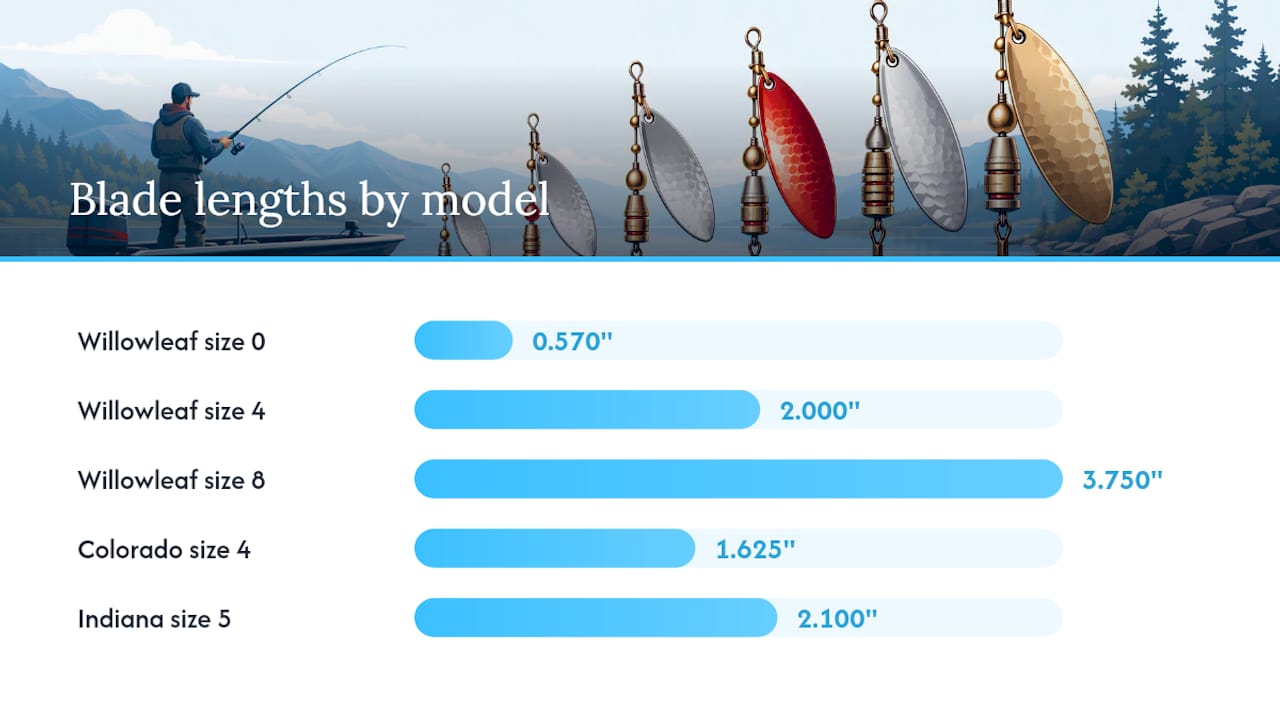
Manufacturer specs on Willowleaf blades run the full range from a tiny size 0 at roughly 0.570 inches all the way up to a size 8 at 3.750 inches, with hole diameter climbing from 0.070 to 0.160 inches as the blade gets bigger. That range covers everything from panfish spinners to full-size Chinook gear on the same numbering system, which is why checking the actual measurement matters more than trusting the size stamped on the package.
Quick inch-to-millimeter conversion for common blade dimensions:
| Inches | Millimeters |
|---|---|
| 0.500" | 12.7mm |
| 1.000" | 25.4mm |
| 1.500" | 38.1mm |
| 2.000" | 50.8mm |
| 2.500" | 63.5mm |
| 3.000" | 76.2mm |
Clevis sizing follows hole diameter, not blade size number. A general rule of thumb:
- Hole diameter under 0.09" pairs with a size 0–1 clevis
- 0.10"–0.13" hole works with a size 3–4 clevis
- 0.14"–0.16" hole needs a size 5–7 clevis or a heavier split ring setup
If your clevis spins loose or binds up mid retrieve, the hole and clevis are mismatched. That single fix solves more “dead” spinner complaints than any color or finish change.
How Do You Measure a Spinner Blade Correctly?
Grab a digital caliper. A ruler with 1/32-inch marks works in a pinch, but calipers get you the precision you need when you’re matching hardware or drilling a custom hole.
Measure in this order:
- Overall length — tip to base, blade laid flat
- Max width — widest point across the belly of the blade
- Hole diameter — measured at the center of the hole, not the outer edge
- Thickness — use a drill gauge or caliper jaws for gauge/mm reading
- Hole placement — distance from the base edge, since off-center holes affect spin balance
Pro Tip: Hammered or textured blades distort slightly during the stamping process, so measure at three points along the length and average them. A blade that reads 0.05 inches off from spec usually still swims fine, but anything more than that and you’ll feel a wobble or rollover on retrieve.
Which Blade Size and Shape Fits Your Fishing Conditions?
Size and shape decisions come down to three things: how clear the water is, how fast the current moves, and how much weight is riding ahead of the blade.
| Condition | Recommended Size/Shape |
|---|---|
| Murky or fast, deep water (Chinook) | Colorado size 4–6 |
| Clear water, faster retrieve (Coho) | Willowleaf size 3–4 |
| Mixed/versatile conditions | Indiana size 3–5 |
| Small, gin-clear streams | Any shape, size 3–4 |
| Heavy current, big river kings | Colorado/Indiana size 6–7 with heavier head |
Blade selection for salmon tracks closely with water clarity: bigger blades push more water for fish to feel in stained or fast conditions, while smaller, flashier blades work better on cautious coho and gin-clear pools. Guides working Alaska rivers often run No. 5 to 6 Colorados on big kings in larger rivers, then scale down to No. 3 to 4 the moment they hit smaller, clear tributaries.
Head weight sets a hard limit on blade size. A 3/8 oz head pairs well with a #4 to #5 blade, while a 1/2 oz head can handle a #6 to #7. Go too big on the blade without enough weight up front, and the whole rig rolls instead of tracking straight. That torque problem is the same principle covered in this rod weight matching guide — balance between components determines whether your gear performs the way it’s designed to.
Pro Tip: Running a small Colorado up front with a medium Willow behind it covers a wider range of conditions than either blade alone. The Colorado gives thump, the Willow adds flash, and together they read well in water that’s neither fully clear nor fully blown out.
Thicker gauge blades vibrate harder at the same size number, so a heavy-gauge size 4 can out-fish a light-gauge size 5 in dirty water. When you’re rebuilding a spinner and the fish quit responding, check gauge before you jump up a full size.
A Working Angler’s Take on Blade Sizing
My go-to combo on Columbia and Willamette systems is a size 5 Colorado paired with a medium Willow trailer, adjusted down to a 3-4 Willow the second the water clears up. These numbers are starting points, not gospel. Local water color, run timing, and how spooky the fish are that week will move you up or down a size fast.
Get the Exact Blades and Hardware to Match These Sizes
Once you know the size number you need, the next step is finding hardware that actually measures out to spec. High Class Tackle Co. sells Colorado, Willowleaf, Indiana, and French blades across multiple gauges, along with the clevises and split rings sized to match them.

Every product page lists the measurement specs shown in the charts above, so you can check length, hole diameter, and gauge before you order instead of guessing from a photo. That matters most when you’re replacing a single blade on a spinner that’s already tuned right and you don’t want to throw off the balance. The Terminal Tackle & Components collection covers blades, clevises, and split rings sized to the charts in this guide, and it’s the fastest way to rebuild a rig without ordering three sizes to find the one that fits. If you’re setting up a full workshop bench, the component tackle box keeps every size sorted so you’re not digging through loose parts mid-season.
Sources
- Willowleaf Spinner Blades - Lakeland Component Solutions
- Spinnerbait blade types & flash patterns - Master Fishing Mag
- Best Spinners for Salmon Fishing (River Guide + Top Picks for Chinook & Coho)
Recommended
- Spinner Blades: The Ultimate Hack for Reeling in More Salmon – High Class Tackle Co.®
- Why Spinner Blades Are a Game-Changer – High Class Tackle Co.®
- Custom Spinner Blades for Salmon and Steelhead Success – High Class Tackle Co.®
- Spinner-Style Blades for West Coast Salmon & Steelhead – High Class Tackle Co.®
0 comments