

Spinnerbaits get a bad rap. A lot of anglers write them off as basic gear for beginners or bass ponds, but that’s a serious mistake. These lures are one of the most versatile, fish-catching tools you can throw in Pacific Northwest waters. Whether you’re chasing chrome steelhead in a glacial river, targeting kokanee in a mountain reservoir, or hunting chinook in tidal flats, a well-rigged spinnerbait can be the difference between a slow day and pure mayhem. This guide breaks down everything you need to know to fish them smarter, choose the right components, and tap into the community-driven culture that makes Northwest fishing so special.
Table of Contents
- What makes a spinnerbait unique?
- Choosing the right spinnerbait for your local waters
- How and when to fish spinnerbaits: Techniques for Northwest anglers
- Common mistakes and overlooked spinnerbait opportunities
- The Pacific Northwest spinnerbait advantage: What most anglers overlook
- Get your spinnerbait essentials from High Class Tackle Co.
- Frequently asked questions
Key Takeaways
| Point | Details |
|---|---|
| Spinnerbait basics | Spinnerbaits use blades and skirts to attract salmon, steelhead, and kokanee with flash and vibration. |
| Tailor to water conditions | Adjust blade shape, skirt color, and retrieval based on clarity and species for best results. |
| Technique matters | Use steady or varied retrieves depending on the season, water, and target fish. |
| Avoid common mistakes | Don’t overuse flash in clear water and be sure to adapt spinnerbaits for local river conditions. |
| Community impact | Experimenting and sharing spinnerbait setups creates a stronger Pacific Northwest fishing culture. |
What makes a spinnerbait unique?
Now that we’ve defined spinnerbaits, let’s break down what makes them so effective in Pacific Northwest waters.
At its core, a spinnerbait is built around three key components: one or more spinning metal blades, a wire frame, and a skirted hook. The blades rotate as the lure moves through the water, creating flash and vibration that fish can detect from impressive distances. The skirt, typically made from silicone or rubber strands, mimics the flowing movement of baitfish, squid, or other prey. As Outdoor Life explains, spinnerbaits create movement and flash using spinning blades plus a skirted hook to trigger strikes.
“The combination of flash, vibration, and lifelike skirt movement creates a multi-sensory attack on a fish’s instincts. It’s not just one trigger — it’s several firing at once.”
That multi-layered stimulus is exactly why spinnerbaits perform so well across species. Salmon and steelhead are highly reactive to flash and movement, especially in low-light conditions or when water clarity drops. Kokanee, which feed heavily on small baitfish and zooplankton, respond to the subtle shimmer and pulsing action of a slow-rolled spinnerbait. The lure’s design essentially speaks the language of Pacific Northwest fish.
Key design features that matter:
- Blades: The spinning element that generates flash and vibration. Blade shape dramatically changes the action and depth at which the lure runs.
- Skirt: Adds bulk, color, and lifelike movement. Skirt length and color are critical variables. Check out hoochie squid skirts for a proven Pacific Northwest option.
- Hook: Usually a single skirted hook or paired with a treble hook trailer for extra holding power on aggressive strikes.
- Wire frame: The backbone of the lure. A quality frame keeps the blade and hook aligned for consistent action.
| Component | Function | Impact on fishing |
|---|---|---|
| Willow blade | Tight spin, deep flash | Best in clear water, fast retrieves |
| Colorado blade | Wide wobble, strong vibration | Best in murky water, slow retrieves |
| Indiana blade | Moderate spin, balanced action | Versatile, works in most conditions |
| Silicone skirt | Lifelike movement | Triggers hesitant fish |
| Treble trailer | Extra hook point | Improves hookup ratio on short strikes |
The blade shape alone can completely change how a fish reacts to your lure. That’s a level of customization most anglers never fully explore.
Choosing the right spinnerbait for your local waters
Understanding spinnerbait components is only half the story; choosing the right setup for your local conditions is where the magic happens.
Pacific Northwest waters vary wildly. You’ve got glacially fed rivers running cold and clear in summer, coastal streams that blow out with rain in fall, and deep inland lakes where kokanee suspend at specific depths. Each environment demands a different approach. As Sports Illustrated notes, success is tied to matching blade, weight, and skirt choices to your specific fishing conditions.
Matching spinnerbait setup to species and conditions:
- Chinook salmon in tidal water: Go heavy, 1 to 1.5 oz, with a wide Colorado blade in chartreuse or white. The strong vibration cuts through current and gets noticed fast.
- Steelhead in river runs: Use a 3/8 to 1/2 oz setup with a Willow blade in silver or gold. Keep the skirt natural, think olive, brown, or pink, to match the hatch.
- Kokanee in reservoirs: Drop down to ultra-light spinnerbaits, 1/16 to 1/8 oz, with small Indiana blades in pink, red, or orange. Kokanee are finicky, so subtle is the name of the game.
- Coho in coastal rivers: Medium weight, 1/2 to 3/4 oz, with a tandem blade setup. Coho love a lure with a bit of attitude, so don’t be afraid to go bright.
Skirt color strategy:
- Bright colors (chartreuse, orange, pink): Use in stained or murky water, overcast days, or early morning. These colors create contrast and visibility when light is low.
- Natural colors (olive, brown, white): Best in clear water or when fish are pressured and wary. Mimics real baitfish more convincingly.
- Dark colors (black, purple): Underrated for low-light conditions. Dark profiles create a strong silhouette that fish can track.
Pro Tip: When fishing a river with varying current speeds, carry two or three different blade weights so you can keep your spinnerbait running at the right depth without constantly adjusting your retrieve speed. A lure that’s dragging bottom or skating the surface isn’t doing its job.
| Water type | Clarity | Best blade | Best skirt color | Weight |
|---|---|---|---|---|
| Coastal river | Stained | Colorado | Chartreuse/orange | 1/2 to 3/4 oz |
| Mountain lake | Clear | Willow | Natural/white | 1/8 to 1/4 oz |
| Tidal flat | Murky | Colorado | White/chartreuse | 1 to 1.5 oz |
| Reservoir | Clear | Indiana | Pink/red | 1/16 to 1/8 oz |
| Glacial river | Cold/clear | Willow | Silver/olive | 3/8 to 1/2 oz |
Also consider selecting the right treble hooks for your trailer. A sharp, correctly sized treble dramatically improves your hookup rate, especially on fish that swipe at the lure without fully committing.
How and when to fish spinnerbaits: Techniques for Northwest anglers
With spinnerbait choices dialed in, the next step is mastering your fishing technique, especially for the changing conditions of Northwest waters.
The most common spinnerbait method is what anglers call the “chuck and wind” approach: cast it out, let it sink to your target depth, and retrieve at a steady pace. It’s simple and it works. But if you stop there, you’re leaving fish in the water.
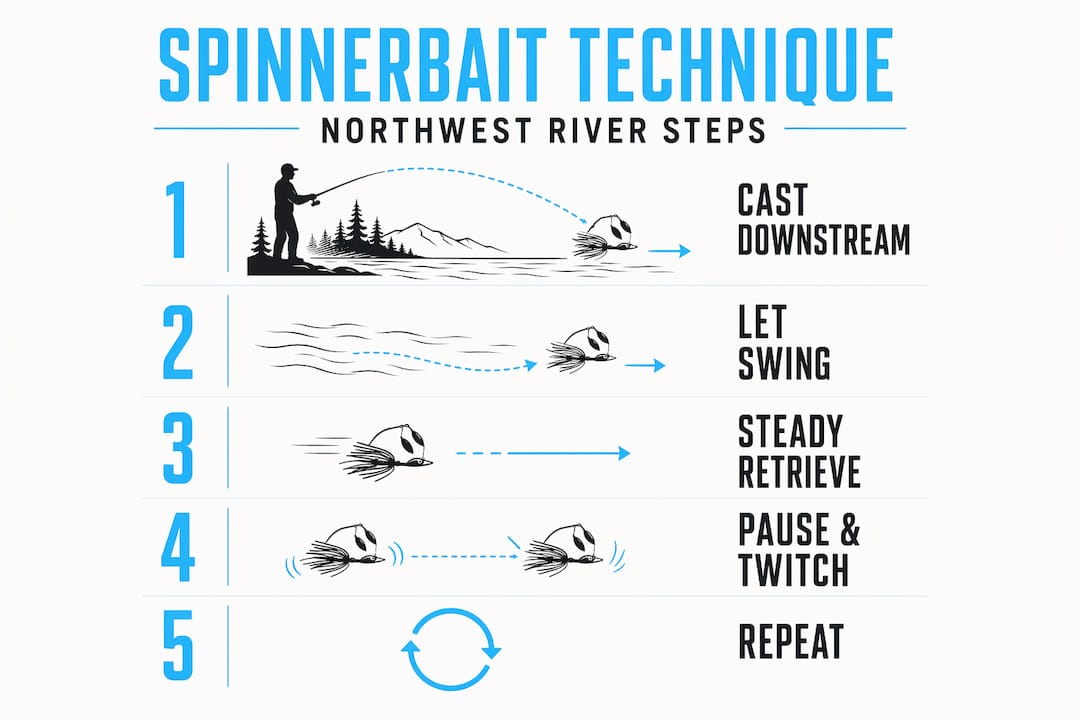
Step-by-step spinnerbait technique for Northwest anglers:
- Cast upstream or across current. Let the spinnerbait sink to your target depth before engaging your retrieve. Counting down (one second per foot of depth) helps you hit the strike zone consistently.
- Start with a steady retrieve. Get a feel for how the lure runs and how much resistance the blade creates. This is your baseline.
- Vary your speed. Speed up briefly, then slow down. This change in action mimics a fleeing or injured baitfish and often triggers reaction strikes from fish that were following.
- Work the edges. Current seams, depth transitions, and structure edges are where fish hold. Run your spinnerbait along these zones rather than through open water.
- Let it flutter on the pause. Occasionally kill your retrieve for one to two seconds. The blade slows, the skirt collapses, and then pulses back to life on the next crank. This pause-and-go action is deadly on steelhead.
- Adjust depth on the fly. If you’re not getting strikes, go deeper or shallower. Change your retrieve speed to control depth without swapping lures.
One critical nuance: flash can look unnatural in very clear water on bright, calm days. On those conditions, tone down your blade flash by choosing a painted or hammered finish instead of polished chrome. Spinnerbaits remain highly effective in stained or murky water where the vibration does most of the work.
Seasonal timing for the Pacific Northwest:
- Spring: Steelhead runs are active. Fish early morning and evening when light is low. Use gold blades and natural skirts.
- Summer: Chinook season. Fish deeper and slower in warmer water. Chartreuse and white dominate.
- Fall: Coho and late chinook. Rivers are often stained from rain. Go bright, go heavy, go loud.
- Winter: Steelhead again. Slow your retrieve way down. Cold water means sluggish fish that won’t chase hard.
Pro Tip: In fast river currents, cast slightly downstream and let the current do the work. The spinnerbait will swing across the current naturally, and you just need to control the depth. This technique is especially effective for steelhead holding in mid-river seams. Pair it with upgraded skirts that pulse and breathe in slower water.
Common mistakes and overlooked spinnerbait opportunities
As you sharpen your spinnerbait skills, it’s equally important to learn from common mistakes and capitalize on innovations that other Pacific Northwest anglers share.
Even experienced anglers make the same spinnerbait errors. The most common is running too much flash in clear, bright conditions. As Game & Fish Magazine points out, spinnerbaits can be less effective on very clear, bright, calm days when the blade flash may look unnatural to fish. Dialing back your flash on those days, by switching to a hammered or painted blade, can completely turn your session around.
“In clear water, less is more. A subtler presentation often outperforms a flashy one when fish have the time and visibility to scrutinize your lure.”
Top spinnerbait mistakes to avoid:
- Wrong skirt color for conditions. Bright colors in clear water spook fish. Natural colors in murky water disappear. Match your skirt to the visibility.
- Ignoring retrieval speed. A one-speed retrieve is predictable. Fish learn to ignore it. Mix up your cadence.
- Fishing too shallow. Most Pacific Northwest species hold deeper than you think, especially in summer heat or cold winter water.
- Neglecting blade maintenance. A bent or nicked blade ruins the action. Check your blades after every session and replace them when they stop spinning true.
- Skipping spinnerbaits in rivers. Many anglers think spinnerbaits are lake lures. Wrong. They absolutely shred in river conditions when fished correctly.
Overlooked opportunities:
- Kokanee on ultra-light spinnerbaits. Most kokanee anglers stick to wedding rings and corn. A tiny spinnerbait in pink or red is a sleeper setup that can outfish traditional rigs on tough days.
- Blade swaps mid-session. Carry a small kit of replacement blades in different shapes and finishes. Swapping from a Willow to a Colorado in the same session can unlock fish that were ignoring you.
- Community knowledge. The Pacific Northwest fishing community is packed with anglers who have dialed in hyper-local techniques. Ask questions at the boat launch. Share what’s working. The best spinnerbait tricks often come from a conversation, not a YouTube video.
Pro Tip: Build a small spinnerbait customization kit with extra blades, skirts, and swivels. Being able to modify your lure on the water, rather than being locked into a factory setup, gives you a serious edge when conditions shift.
The Pacific Northwest spinnerbait advantage: What most anglers overlook
Here’s our honest take: most anglers treat spinnerbaits like a simple tool. Cast it out, wind it back, hope for the best. That approach works sometimes. But it misses the bigger opportunity that Pacific Northwest fishing culture actually offers.
The real edge isn’t in the lure itself. It’s in the community around it. Northwest anglers are some of the most innovative, collaborative, and passionate in the country. When you tap into that network, you stop fishing in isolation and start fishing smarter. Blade swaps, skirt color experiments, local river mods, and group outings where everyone tests a different setup — that’s how the best spinnerbait techniques actually get developed out here.
We’ve seen anglers completely transform their success rate not by buying a new rod or a more expensive lure, but by showing up to a community event, watching how someone else rigs their spinnerbait, and asking one good question. That exchange of knowledge is more valuable than any single piece of gear.
Spinnerbaits are also one of the best bridge lures between experienced anglers and newcomers. They’re simple enough for a first-timer to fish effectively on day one, but complex enough to reward years of experimentation. If you’re an experienced angler, hand a newcomer a spinnerbait and walk them through the basics. You’ll be surprised how quickly they start catching fish, and how much you enjoy teaching it.
The standard “chuck and wind” description undersells what spinnerbaits can do. The real fun starts when you start modifying, experimenting, and sharing. That’s where Pacific Northwest fishing culture lives, and that’s where High Class Tackle Co. was built.
Get your spinnerbait essentials from High Class Tackle Co.
To put these strategies into action, you’ll want top-grade spinnerbait gear. Here’s how High Class Tackle Co. delivers what you need.
We build gear for real Pacific Northwest conditions. Not generic tackle shelf stuff. Actual components that perform on the rivers, lakes, and tidal flats you fish every week.

Start with our spinnerbait skirts pack, designed to pulse and breathe in current and still water alike. Add our premium treble hooks for trailer setups that hold fish even on aggressive strikes. And explore our full fishing blades collection to find the exact blade style and finish for your local water.
Essential spinnerbait gear for Pacific Northwest anglers:
- Hoochie squid skirts in chartreuse, pink, and natural colors
- Premium treble hooks in sizes 4, 6, and 8
- Colorado, Willow, and Indiana blades in multiple finishes
- Quality swivels and wire frames for custom builds
Build your kit, hit the water, and let us know what’s working.
Frequently asked questions
What is a spinnerbait and how does it work?
A spinnerbait is a lure that uses spinning blades and a skirted hook to create flash and vibration, provoking fish to strike through a combination of visual and sensory triggers.
What species are spinnerbaits best for in the Pacific Northwest?
Spinnerbaits are highly effective for salmon, steelhead, and kokanee because their flash and vibration match the movement of the baitfish these species actively hunt.
Do spinnerbaits work in clear water?
In clear, bright conditions, blade flash can look unnatural to fish, so switch to painted or hammered blades and natural skirt colors to stay effective without spooking wary fish.
What is the easiest spinnerbait technique for beginners?
The “chuck and wind” method is the most beginner-friendly approach: cast your spinnerbait, let it sink to depth, and retrieve at a steady pace while matching your blade and skirt to current conditions.
0 comments