

Tide fishing salmon bays is most productive during moving water, specifically from the incoming tide through high slack, when salmon chase baitfish pushed by tidal currents. This is not a casual observation. Tidal currents act as a conveyor belt moving prey into feeding lanes, making periods of tide change far more productive than static high or low water. In Pacific Northwest bays like Elliott Bay and Buoy 10, anglers who time their sessions around tidal windows consistently outfish those who show up on a schedule. The right gear, the right timing, and a solid understanding of how salmon relate to current are the three things that separate limits from skunks.
How does tide fishing in salmon bays actually work?
Salmon do not feed randomly. Their behavior is tightly linked to tidal movement and where that movement concentrates baitfish. Moving water stimulates salmon feeding by pushing herring, anchovies, and sand lance into predictable current seams and pinch points. Salmon stack at the edges of those seams and ambush prey with minimal effort. That is the core mechanic you are working with every time you drop a line in a coastal bay.
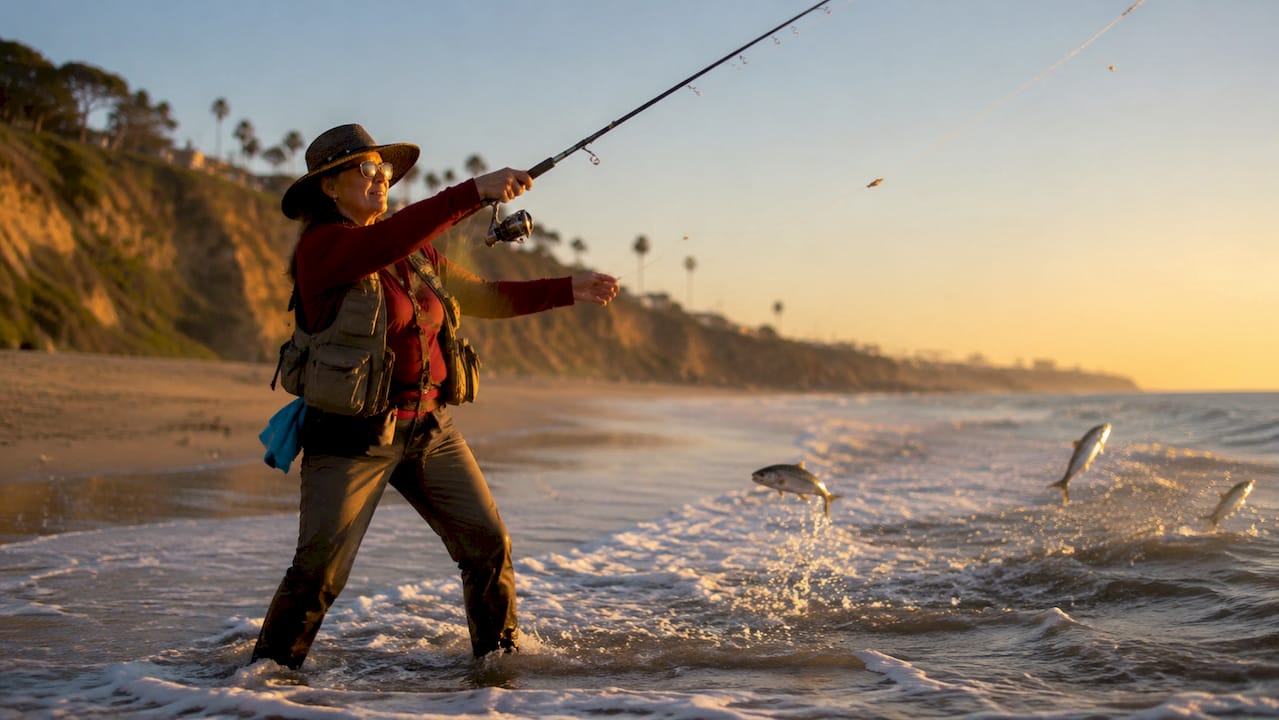
The most productive phase is the incoming tide through high slack. As water floods into a bay, it funnels baitfish toward structure, points, and drop-offs. Salmon follow. The bite often fires hardest in the 1–2 hours before high slack, then tapers as the water stalls. Low slack is generally dead water. The outgoing tide can also produce, especially early in the ebb, but the incoming tide is the primary window most PNW guides target.
Moon phase adds another layer. Fishing 45 minutes before moonrise on new and full moons triggers the strongest spring tide surges, pulling salmon from open water into estuaries. Spring tides during new and full moon phases create the most aggressive tidal movement of the month. If you can align a new or full moon with an incoming tide, you have the best possible setup for a big day.
- Incoming tide through high slack: primary feeding window
- 1–2 hours before and after high slack: peak bite period
- New and full moon spring tides: strongest salmon movement into bays
- Current seams near drop-offs and points: highest fish concentration
Pro Tip: Mark your tide chart with the 1–2 hour windows before and after high slack. Those are your non-negotiable fishing hours. Everything else is bonus time.
What gear do you need for tidal salmon fishing in bays?
Gear selection for bay salmon fishing depends on depth and current speed. In Elliott Bay, salmon hold at 60–120 feet, requiring downriggers and 11-inch flashers to reach the strike zone. A downrigger lets you dial in exact depth and keep your presentation in the zone regardless of boat speed or current. Without one, you are guessing.
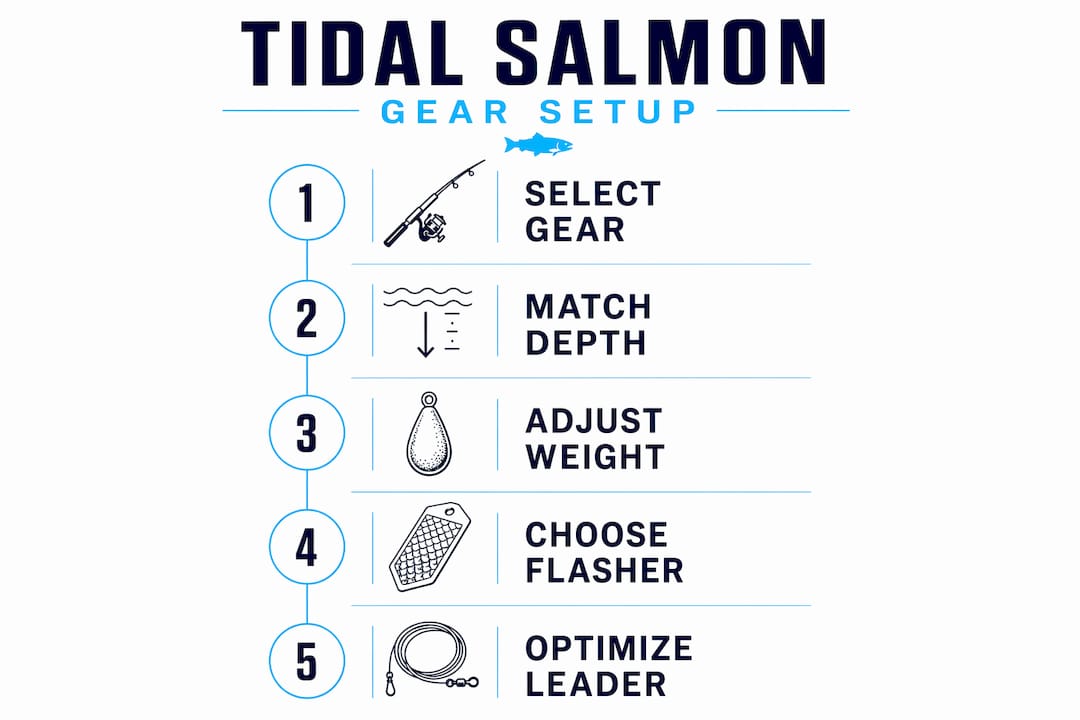
Mooching is the other dominant technique in PNW bays. Mooching rigs with Gamakatsu hooks and soft-tipped rods excel at detecting the subtle, pressure-style bite of Chinook in tidal current. Soft-tipped rods load slowly, giving the fish time to commit before you set the hook. Locations like Buoy 10 and Westport have been built on this technique for decades.
Current speed dictates weight and leader length. When current exceeds 2 knots, switch to heavier weights, shorten your leader, or move to shallower water to maintain lure contact. Lighter setups get blown out of the strike zone fast in heavy current.
| Setup | Technique | Depth | Best Tide Phase | Key Gear |
|---|---|---|---|---|
| Downrigger trolling | Trolling | 60–120 ft | Incoming to high slack | 11-inch flasher, downrigger, 20–30 lb leader |
| Mooching rig | Mooching | 30–80 ft | Slack to light current | Gamakatsu hooks, soft-tipped rod, 4–6 oz weight |
| Anchor fishing | Still fishing | 20–50 ft | High slack | Cut plug herring, circle hooks, medium-action rod |
Pro Tip: In fast current, add 2–4 oz of weight and shorten your leader to 18–24 inches. This keeps your bait in the strike zone instead of riding up in the water column.
For flasher selection in tidal conditions, the 360 flasher guide for PNW salmon breaks down which rotations and sizes perform best at different current speeds.
How do you read tide charts for salmon fishing windows?
A tide chart is your most important planning tool. The goal is to identify the incoming tide phase, locate high slack, and build your fishing session around the 1–2 hours on either side of that peak. Most NOAA tide charts give you predicted times and heights for a reference station. Your actual fishing spot may not match that station exactly.
Local tidal lag in complex bay systems can delay tide peaks by 1–2 hours compared to the reference station. Kachemak Bay is a documented example where geographic features push the actual tide peak well past the predicted time. Always check whether your bay has a correction factor listed for secondary stations. Missing that adjustment means you could be fishing dead water when you think you are hitting peak current.
Here is a practical timing framework for a typical incoming tide session:
| Tide Phase | Timing | Recommended Action |
|---|---|---|
| Early incoming | 2–3 hours before high slack | Position near structure, start trolling |
| Mid incoming | 1–2 hours before high slack | Increase speed, target current seams |
| High slack | At predicted high | Switch to mooching or anchor fishing |
| Early ebb | 30–60 minutes after high | Continue mooching, watch for bite drop-off |
| Mid ebb | 1–2 hours after high | Reassess, move to new structure if bite dies |
Planning fishing around tides rather than fixed clock times produces consistently better results. The tide does not care what time you planned to launch. Build your day around the water, not your schedule.
- Check NOAA tide predictions the night before
- Apply secondary station corrections for your specific bay
- Mark the 1–2 hour windows flanking high slack
- Note moon phase and flag new or full moon dates as priority sessions
Trolling vs. mooching vs. anchor fishing: which works best by tide phase?
Each technique has a specific window where it outperforms the others. Knowing when to switch is what separates consistent producers from anglers who grind all day on one method.
Trolling works best during the active incoming tide when current is moving at a moderate pace. You cover water, stay in the strike zone at depth with a downrigger, and let the flasher do the work. The 11-inch flasher creates enough action to pull fish from a distance in murky bay water. Trolling loses effectiveness as current slows near slack because your lure loses natural action at low boat speeds.
Mooching takes over at slack tide and in light current. You drop a rigged herring or anchovy on a mooching setup, let it spiral down, and work it with subtle rod lifts. Switching between trolling and mooching as conditions evolve is the move that most experienced PNW anglers make without thinking twice. The technique change matches the fish’s behavior at each phase.
Anchor fishing is the most underused method in bay salmon fishing. At high slack, anchoring over a known drop-off or current seam and presenting cut plug herring on a circle hook is deadly. You are not fighting current, you are not burning fuel, and you are sitting right on top of the fish.
- Trolling: Best in moderate incoming current, 60–120 ft depth, flasher required
- Mooching: Best at slack tide and light current, 30–80 ft, soft-tipped rod required
- Anchor fishing: Best at high slack over structure, 20–50 ft, cut plug herring most effective
For more on PNW salmon techniques at tidal river mouths, the Buoy 10 fishing guide covers the specific conditions at one of the most productive tidal salmon fisheries on the West Coast.
Key Takeaways
Tide fishing salmon bays requires timing your sessions around moving water, matching your technique to current speed, and reading local tide charts with secondary station corrections applied.
| Point | Details |
|---|---|
| Fish the moving tide | The incoming tide through high slack is the most productive window for bay salmon. |
| Moon phase matters | New and full moon spring tides create the strongest salmon movement into estuaries. |
| Match technique to current | Troll in moderate current, mooch at slack, anchor fish at high slack over structure. |
| Apply tidal lag corrections | Bay geography can delay tide peaks by 1–2 hours; use secondary station data. |
| Adjust gear for current speed | Current over 2 knots demands heavier weights and shorter leaders to stay in the strike zone. |
What I’ve learned from years of reading PNW tides wrong
The biggest mistake I made early on was treating tide charts like a suggestion. I would show up at a bay based on when I could launch, fish hard for four hours, and wonder why the bite was dead. The answer was always the same. I was fishing the wrong phase.
Salmon position near drop-offs, points, and current seams where tidal velocities concentrate baitfish. That is not a theory. That is what you see on the fish finder when you finally start moving with the tide instead of against it. The fish are not spread out. They are stacked in specific spots that only activate when the current is right.
The other thing nobody talks about enough is tidal lag. I spent two seasons fishing Puget Sound bays off the predicted high tide time and consistently missing the bite by 45 minutes to an hour. Once I started applying secondary station corrections, my timing locked in. The fish were always there. I just kept showing up late.
My honest advice: stop chasing hotspots and start chasing conditions. The best bay on a dead tide is worse than a mediocre bay on a screaming incoming. Build your sessions around the water, bring both a trolling setup and a mooching rig, and be willing to switch methods mid-session. The anglers who adapt are the ones who fill coolers.
— Nick
Gear up for your next tidal salmon session
Ready to put these techniques to work? Highclasstackleco has the PNW salmon gear built for exactly these conditions, from mooching rigs and flashers to terminal tackle that performs in real tidal current.

Whether you are rigging up for Elliott Bay, Buoy 10, or any coastal bay from Washington to Oregon, Highclasstackleco’s full tackle lineup covers everything you need. The component tackle box keeps your mooching rigs, hooks, and weights organized and ready to swap fast when conditions change. Check current Oregon ocean salmon regulations before you head out. Daily bag limits and minimum size requirements vary by species and season, and staying legal is part of fishing right.
FAQ
What is the best tide for salmon fishing in bays?
The incoming tide through high slack is the most productive period. Salmon feed most aggressively when tidal current is moving and pushing baitfish into feeding lanes.
How do I find the peak bite window using a tide chart?
Identify the predicted high slack time and mark the 1–2 hours before and after it. Apply any secondary station corrections for your specific bay to avoid missing the actual peak by an hour or more.
Does moon phase affect salmon fishing in bays?
Yes. New and full moon spring tides produce the strongest tidal surges and pull the most salmon into estuaries. Fishing 45 minutes before moonrise on those dates targets the peak surge.
When should I switch from trolling to mooching?
Switch to mooching when current slows near slack tide. Trolling loses effectiveness at low current speeds, while mooching with a soft-tipped rod and Gamakatsu hooks excels in light or still water.
What depth do salmon hold at in PNW bays?
Salmon in bays like Elliott Bay typically hold at 60–120 feet. Downriggers are required to reach and maintain that depth while trolling.
Recommended
- Northwest Bait and Scent Guide for Serious Anglers – High Class Tackle Co.®
- BC Sockeye Fishing Tackle Guide for PNW Anglers – High Class Tackle Co.®
- Spinnerbait guide: boost your Pacific Northwest fishing – High Class Tackle Co.®
- Steelhead Spoon Fishing Rivers: PNW Angler’s Guide – High Class Tackle Co.®
0 comments