

Picking the wrong fishing line for steelhead can cost you the fish of a lifetime. The types of fishing line for steelhead span monofilament, braid, fluorocarbon, and specialized fly lines, and each one performs differently depending on your method, water clarity, and temperature. A drift fisherman on the Skykomish needs a completely different setup than a spey angler swinging flies on the Deschutes. This guide breaks down every line type by fishing scenario so you stop guessing and start landing more chrome.
Table of Contents
- Key criteria for choosing steelhead fishing lines
- Monofilament fishing line for steelhead
- Braided fishing line for steelhead
- Fluorocarbon lines and leaders in steelhead fishing
- Fly fishing lines and setups for steelhead
- Comparing fishing line types for steelhead: pros, cons, and best uses
- Choosing the right fishing line for your steelhead fishing scenario
- Why no single fishing line is best and how to adapt your setup
- Gear up with trusted steelhead fishing tackle and line options
- Frequently asked questions
Key Takeaways
| Point | Details |
|---|---|
| No single best line | Success depends on choosing line types matched to method, water, and conditions. |
| Monofilament strengths | Mono excels in stretch and cold water, forgiving hooksets for many drift and plunking methods. |
| Braided sensitivity | Braid offers no stretch and thin diameter for high sensitivity and longer drifts. |
| Fluorocarbon leaders | Fluorocarbon reduces visibility and abrasion, crucial for leader stealth and fly presentation. |
| Fly line tailored | Fly line selection hinges on steelhead fly fishing method and season for optimal presentation. |
Key criteria for choosing steelhead fishing lines
Before you spool up, you need to understand what actually matters when selecting a line. Not every factor applies equally to every method, but these are the variables that separate a good setup from a great one.
- Sensitivity: The ability to feel subtle ticks and bumps as your drift moves through the run. More sensitivity means faster hooksets.
- Stretch: High-stretch lines absorb shock on hard strikes. Low-stretch lines transmit every bump directly to your hand.
- Visibility: Steelhead have sharp eyesight. In clear PNW rivers, a visible mainline can shut down bites completely.
- Cold weather performance: Below freezing, some lines stiffen or become brittle. This matters on January rivers in Washington and Oregon.
- Leader compatibility: Your mainline and leader must work together. A heavy, visible mainline kills the stealth your fluorocarbon leader creates.
A PNW steelhead guide in 2026 frames line choice as a tradeoff between sensitivity and hooksets on one side, and presentation and forgiveness on the other. Neither braid nor mono wins outright. The right call depends on your conditions.
Pro Tip: Before your next river session, check the water temperature. If it’s dropping below 32°F overnight, swap braid for mono to avoid ice buildup in your guides and brittle line behavior at the worst possible moment.
Pairing your line with the right steelhead fishing gear essentials makes the whole system work harder for you.
Monofilament fishing line for steelhead
Monofilament is the old reliable of steelhead fishing, and for good reason. It stretches. That stretch acts like a shock absorber when a winter steelhead explodes on your bait and runs hard downstream. You get a little forgiveness that braid simply cannot offer.
Mono is popular for drift and cold conditions due to its stretch and shock absorption, making it forgiving and well-suited for float fishing and plunking methods. In cold water, mono stays supple and manageable when braid turns into a frozen mess in your guides.
Monofilament strengths for steelhead:
- Stretches 20 to 30 percent, reducing break-offs on aggressive strikes
- Performs reliably in near-freezing water temperatures
- Floats, which helps with float fishing and reading your drift
- High-visibility options make bite detection easier under a bobber
- Budget-friendly and widely available at most PNW tackle shops
Typical pound tests run 8 to 14 lbs for mainline. Most drift anglers run 10 lb mono on the main spool and tie on a 6 to 8 lb fluorocarbon leader for stealth at the business end. Plunking setups often go heavier, up to 14 lb, to handle the weight of heavy sinkers and the stress of holding bottom in big water.
Pro Tip: Use high-visibility pink or red mono as your mainline when float fishing. The bright color helps you track your float’s movement and detect subtle pauses that signal a bite, without spooking fish since the leader separates your hook from the colored line.
Pair your monofilament line options with quality terminal gear to finish the setup right.
Braided fishing line for steelhead
Braid is the choice for anglers who want to feel everything. No stretch means every tick of a rock, every subtle grab, travels straight up the line to your fingertips. On longer drifts where you need to detect a bite 60 feet downstream, that sensitivity is a real advantage.
Braided lines offer greater sensitivity, thinner diameters for less current drag, and solid hooksets on longer drifts, but they are less suitable below freezing temperatures. That thin diameter is underrated. A 20 lb braid is roughly the same diameter as 6 lb mono, which means less line pushing through the current and a more natural drift presentation.
Braided line strengths and weaknesses:
- Zero stretch delivers instant hookset feedback
- Thin profile cuts through current with less drag
- Casts farther and more accurately than equivalent mono
- Holds up over multiple seasons without significant memory
- Poor performance below freezing; guides ice up fast
- Less forgiving on hard strikes; requires smooth drag settings
Braid shines hardest in summer and fall steelhead runs when water temperatures stay above freezing and you’re covering water with lures or side drifting. When winter hits and temps drop, switch to mono or at minimum carry both spools.
Pro Tip: When running braid as your mainline, always use a fluorocarbon leader of at least 4 feet. Braid is highly visible in clear water. The leader creates an invisible transition zone between your line and your presentation.
Explore braided steelhead lines that hold up through a full season of hard fishing.
Fluorocarbon lines and leaders in steelhead fishing
Fluorocarbon does not get enough credit as a standalone topic. Most anglers think of it only as a leader material, which is accurate, but understanding why it works changes how you use it.
Fluorocarbon has a refractive index close to water, meaning it nearly disappears underwater. In gin-clear PNW rivers like the upper Methow or the Klickitat, that invisibility directly translates to more strikes from pressured fish. It also resists abrasion better than mono, which matters when your leader is dragging across gravel and submerged rocks all day.
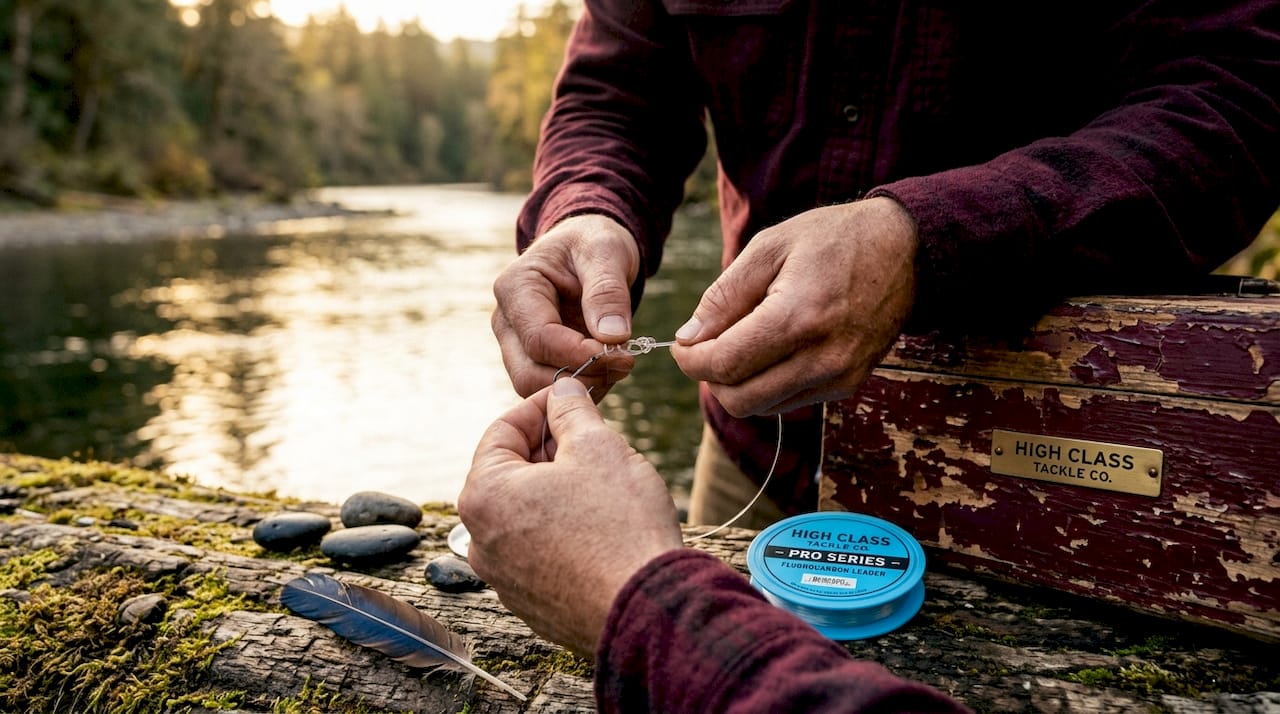
Fluorocarbon leaders are widely recommended for reducing visibility and improving sensitivity, typically running 3 to 6 feet long depending on method and water clarity. In clearer, shallower conditions, longer leaders of 10 to 12 feet are suggested to distance flies from fly line splash and enhance stealth.
Fluorocarbon leader best practices:
- Use 8 to 12 lb fluorocarbon for drift and side drifting
- Go lighter, 6 to 8 lb, in clear, low water conditions
- Run 10 to 12 foot leaders in fly fishing setups on clear rivers
- Choose a supple fluorocarbon brand for better knot strength and fly presentation
- Stiffer fluorocarbon works well for plunking where presentation control matters less
Pro Tip: Not all fluorocarbon is the same. Stiff fluorocarbon holds knots well but can cause fly spin in current. Supple fluorocarbon flows naturally but can be harder to tie clean knots with. Match the stiffness to your method.
Check out fluorocarbon leaders for steelhead built for the specific demands of PNW rivers.
Fly fishing lines and setups for steelhead
Fly fishing for steelhead opens up an entirely different world of line selection. You are not just picking a pound test. You are choosing a system that determines how your fly lands, swings, and drifts through the water column.
Two primary approaches drive fly line selection:
- Indicator nymphing: Uses a weight-forward floating line, a strike indicator, and a long leader system to dead-drift nymphs through runs. The floating line must mend easily to control drift speed.
- Spey and swing fishing: Uses either a Skagit head or a Scandi head attached to a running line. Skagit heads are heavy and designed for winter fishing with sinking tips and large flies. Scandi heads are lighter and better for summer steelhead with smaller, lighter flies.
Weight-forward floating lines paired with indicators suit nymphing, while Skagit and Scandi heads cater to swinging flies in winter and summer conditions respectively. The best fly line depends on your preferred method, with options like the RIO Elite Salmon/Steelhead recommended as versatile all-purpose choices.
| Fly line type | Best season | Technique | Tip/Leader |
|---|---|---|---|
| Weight-forward floating | Year-round | Indicator nymphing | Long mono/fluoro leader |
| Skagit head | Winter | Swinging heavy flies | Sinking tip, 3-5 ft leader |
| Scandi head | Summer/fall | Swinging lighter flies | Floating tip, longer leader |
| RIO Elite Salmon/Steelhead | Year-round | Versatile all-purpose | Varies by setup |
Mending ability matters more than most beginners realize. A line that does not mend cleanly will drag your fly unnaturally through the run, and steelhead will ignore it.
Comparing fishing line types for steelhead: pros, cons, and best uses
Here is the full picture side by side. Use this as your quick reference when you are rigging up for a new river or a new method.
| Line type | Stretch | Visibility | Cold performance | Best use |
|---|---|---|---|---|
| Monofilament | High | Medium to high | Excellent | Float fishing, plunking, cold water drift |
| Braided | None | High | Poor | Side drifting, lure casting, warmer water |
| Fluorocarbon | Low | Very low | Good | Leaders for all methods |
| Fly line (WF floating) | Low | N/A | Good | Indicator nymphing |
| Skagit head | Low | N/A | Good | Winter swinging |
| Scandi head | Low | N/A | Good | Summer swinging |
Guides recommend monofilament or braid for most drift and float fishing, adding fluorocarbon leaders to both setups for stealth. Fly line type selection depends on presentation style, with weight-forward lines for nymphing and Skagit or Scandi heads tailored by season.
Explore detailed steelhead fishing line options to match your specific method and river.
Choosing the right fishing line for your steelhead fishing scenario
Let’s put it all together by method. These are the setups that consistently produce fish across PNW rivers.
- Drift fishing: Run 8 to 14 lb mono or braid as your mainline. Attach a 4 to 6 foot fluorocarbon leader. In water below 35°F, favor mono for its cold-weather performance and stretch.
- Plunking: Go heavier. Use 12 to 14 lb mono or 20 to 30 lb braid with a long fluorocarbon leader of 4 to 6 feet to reduce visibility near your bait.
- Side drifting: Side drifting typically uses 8 to 12 lb braid or mono mainline with a 3 to 6 foot fluorocarbon leader for stealth and clean presentation.
- Fly fishing (nymphing): Match a weight-forward floating line with a long leader system and a fluorocarbon tippet section of at least 2 to 3 feet.
- Fly fishing (swinging/spey): Select your Skagit or Scandi head based on season, then add the appropriate tip and a short fluorocarbon leader of 3 to 5 feet.
A common preference among experienced PNW anglers is braid mainline paired with a 4 to 6 foot fluorocarbon leader for the best balance of sensitivity and stealth. It is a system that works across multiple methods and river types.
Pro Tip: Always factor in fishing pressure. On heavily fished rivers like the Hoh or the Sandy, drop down a leader size and extend your leader length. Pressured steelhead get educated fast.
Build your setup around the right steelhead fishing line setups and you will be dialed in before you even hit the water.
Why no single fishing line is best and how to adapt your setup
Here is the truth most fishing articles skip: the obsession with finding the perfect line is the wrong way to think about it. We have seen anglers spend more time debating braid versus mono online than they spend on the water reading fish. That is backwards.
Line choice is ultimately a tradeoff between sensitivity and presentation, cold weather suitability and stretch. There is no single best line for all conditions. The anglers who consistently catch steelhead are not the ones with the most expensive setup. They are the ones who understand why each line behaves the way it does and make adjustments on the fly.
A guide we respect runs braid from September through November, switches to mono in December when the Snoqualmie drops into the low 30s, and goes back to braid in March when temperatures climb. That seasonal flexibility is worth more than any single line choice. The fluorocarbon leader stays constant year-round, regardless of what is on the main spool. That is the real constant in every great steelhead setup.
River reading beats gear obsession every time. Know where fish hold in different flows, understand how water temperature affects fish behavior, and then pick the line that best serves your presentation in those conditions. The gear follows the strategy, not the other way around.
Gear up with trusted steelhead fishing tackle and line options
You now know exactly which types of fishing line for steelhead match your method and conditions. The next step is putting together a complete setup that performs when it counts. At High Class Tackle Co., we build our gear for the rivers and fish we chase ourselves.
Stock up on treble hooks for steelhead fishing that hold through hard runs and heavy current. Add some steelhead lure accessories to round out your presentation game. And if you want to rep the culture on and off the water, our angler lifestyle apparel is built for people who live this life. Gear up, get out, and go find some chrome.
Frequently asked questions
What is the best type of fishing line for steelhead fishing?
There is no single best line. Monofilament offers stretch and cold-water performance, braid delivers sensitivity and strength, and fluorocarbon leaders add stealth and abrasion resistance. The right choice depends on conditions, not a universal recommendation.
How long should my fluorocarbon leader be for steelhead fishing?
Leaders typically run 3 to 6 feet for general drift and side drifting setups. In clear water, extend to 10 to 12 feet to keep your fly or bait well away from the visible mainline.
Is braided line better than monofilament for steelhead?
Braid is more sensitive with zero stretch, making it ideal for longer drifts and lure casting. Mono is better in cold temperatures and provides more shock absorption, making it the safer call in winter conditions.
What fly lines are recommended for steelhead fly fishing?
Weight-forward floating lines work well for indicator nymphing. Skagit heads suit winter swings with heavy tips, while Scandi heads are better for summer steelhead with lighter flies and more delicate presentations.
0 comments